What's the story behind the story? What inspired you to write this book?
To explain what inspired When Gods Walked the Earth, I should probably begin with The Ignoble Lie, the first book in the series. When writing The Ignoble Lie, I became fascinated by the possibility that certain figures in the Bible might actually have been representations of historical individuals, particularly given the scarcity of independent historical evidence for the existence of many biblical characters. I began wondering whether some familiar religious narratives might have originated in actual historical events and personalities, only to be transformed over time. With When Gods Walked the Earth, I wanted to continue the story while exploring a related but different question: What if the gods and goddesses of antiquity were originally extraordinary men and women—powerful rulers, influential leaders, or remarkable individuals—who gradually became deified through legend and tradition?
From there, my imagination took things a step further: What might happen if someone tried to recreate those gods in the modern world? Both novels grew out of my fascination with the often-blurred boundaries between history, mythology, and religion, and with how stories about the past can shape what we believe in the present.
If you had to pick theme songs for the main characters of your book, what would they be?
Now you’ve hit on one of my absolute favorite topics: the importance of music to my writing process!
I find it difficult to listen to music with lyrics while writing, so for years I mostly listened to classical music. Over the past couple of years, however, I’ve discovered something wonderful: post-rock, much of which—or at least the kind I gravitate toward—is instrumental.
So, rather than choosing theme songs for individual characters, I’d like to mention a few bands whose music helps create the atmosphere that inspires my writing.
At the very top of my list is Grails, a band from Portland, Oregon. Their music has an almost mythic, occasionally occult quality that I find especially compelling. I highly recommend them to anyone looking for atmospheric writing music. I’d also mention Barn Owl, with their dark, hypnotic drone soundscapes, and Red Sparrows, whose sweeping instrumental compositions can be wonderfully evocative.
Did I mention that I’m not a huge fan of mainstream music? LOL.
Although I must make one very important exception: long may Dolly Parton reign! I admired her not only for her extraordinary music but also for her kindness, generosity, and humanity. She was truly one of a kind, and she’ll be deeply missed.
What's your favorite genre to read? Is it the same as your favorite genre to write?
My favorite genres to read aren't exactly the same as what I write, though there's certainly some overlap. Essentially, I write political-religious thrillers, and one of my favorite parts of the process is the research involved. I love reading nonfiction about the subjects I explore in my novels. In fact, that's often where my ideas come from. So I read a great deal about history, religion, and politics.
That said, I also love literary fiction, especially novels written over the past couple of centuries. When I'm not researching a book of my own, chances are I'm reading a novel by someone who's been dead for decades—or even centuries.
In fact, my wife made me a T-shirt featuring a gravestone with the words “I Read Dead People” above it. A little nod to The Sixth Sense. LOL.
And uh-oh, don't even get me started on horror movies. That's a ten-hour conversation about another one of my favorite things!
What books are on your TBR pile right now?
I'm going to try to make this shorter than my actual TBR pile because a complete response risks breaking the Internet. This may sound funny, but at the top is War and Peace, mainly because it's one of the few major Russian classics I haven't gotten around to reading. (For those of you who are interested, I prefer Dostoevsky.) After that, there's Giacomo Leopardi's Canti, Cesare Pavese's Dialogues with Leucò, Dialectic of Enlightenment by Max Horkheimer and Theodor Adorno, In the Closet of the Vatican by Frédéric Martel, and The Stories of Algernon Blackwood. So, yeah, I don't get out much! LOL.
What scene in your book was your favorite to write?
Since I'm a writer and not a mathematician, I'll proceed to mention a few of my favorite scenes. Unfortunately, I can't go into too much detail without giving away some of the surprises! In When Gods Walked the Earth, I'd have to choose the surreal ceremonies that take place deep within the Apostolic Palace at the Vatican and beneath the dome of the U.S. Capitol in Washington, D.C. As for The Ignoble Lie, the opening scene is among my favorites, as is the time one of the characters spends in—or perhaps I should say under—Jerusalem.
Do you have any quirky writing habits? (lucky mugs, cats on laps, etc.)
One of the things I find most interesting and rewarding about writing fiction is the opportunity to see the world through the eyes of people from many different walks of life. But portraying a perspective different from your own requires getting outside yourself and inhabiting a character as fully as possible.
One thing that helps me do that is my hat collection.
It's a little hard to explain, but putting on a different hat somehow helps me change my perspective and outlook. It also helps me relax and take myself a lot less seriously.
After all, it's hard not to laugh at yourself when you're wearing a hat shaped like a bear's head—especially one that growls when you squeeze its ears. And looking out through the mouth of a shark (another favorite) certainly gives you a different perspective, as does pretending you're a member of the cast of Pirates of the Caribbean.
I know what you might be thinking...
But somehow, despite all this, I managed to marry the world's finest woman.
Do you have a motto, quote or philosophy you live by?
Some days, I live according to my belief in the Golden Rule: Whoever has the gold makes the rules. ☹
Most of the time, however, I try to live by the belief that you should treat others the way you would want to be treated.
I've occupied a lot of different positions in life and covered quite a bit of ground. I've gone from dropping out of high school to earning a Ph.D., and from being homeless years ago to owning a house.
Along the way, I've learned that most people want the same basic things: food, shelter, clothing, and the opportunity to improve their lives. I think it's far more important to cherish these commonalities than to deify our differences.
At the end of the day, I believe most people simply want to be treated with decency and respect. And I think anyone who's sincerely trying to become a better person deserves that consideration.
We're all works in progress. If we can do a little better today than we did yesterday, I think that's half the battle.
If you could choose one thing for readers to remember after reading your book, what would it be?
Amid the ocean of books in the world, it's always challenging—and perhaps even a little presumptuous—to offer yet another one. So when I write, I hope to give readers something more than an entertaining story. I hope to give them something to think about.
One of the things I try to do in my novels is ground the stories in the real world, with a framework of historical plausibility and contemporary relevance. That requires a good deal of research, but I believe it's worth the effort. By placing fictional events within a believable context, I hope to encourage readers to look at familiar ideas, particularly those involving history, religion, and politics, from perspectives they might not have considered before.
Franz Kafka once wrote, and I'm paraphrasing here, that a book should be the axe that breaks the frozen sea within us. I've always loved that image, and I hope my books accomplish something along those lines.
I've found that my novels sometimes generate strong reactions, and I don't necessarily consider that a bad thing. We live in a time when it's especially important to examine our beliefs, to ask why we hold them, and to remain willing to discuss them with people who see the world differently.
Ultimately, I don't ask readers to agree with me. If one of my books encourages someone to question a long-held assumption, consider a different perspective, or engage in a conversation they might otherwise have avoided, I'll consider that a success. Because the freedom to ask questions—and to disagree about the answers—is something we should never take for granted.
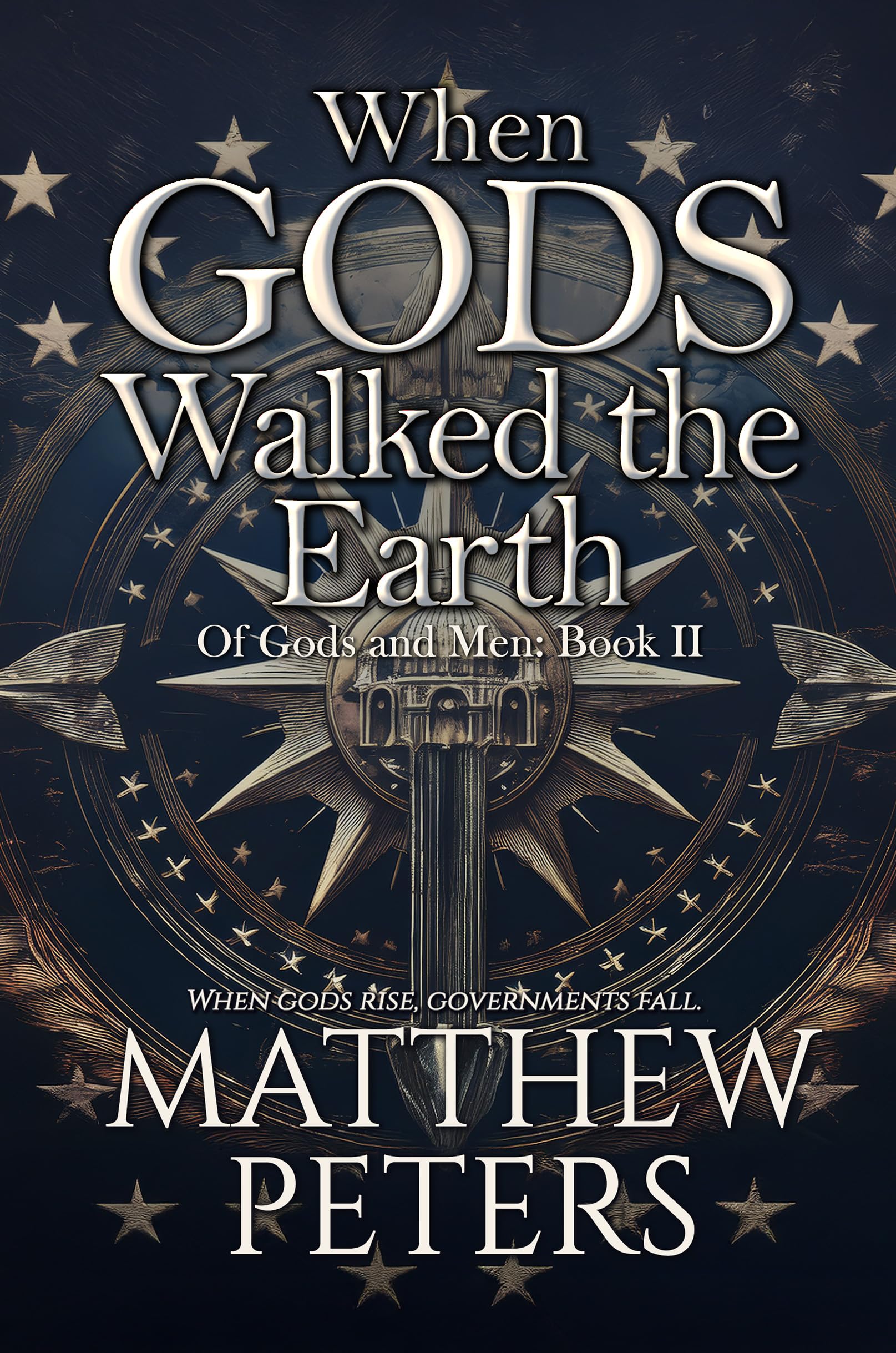
Matthew Peters is the author of the new book When Gods Walked the Earth (of Gods & Men Book 2)
Connect with Matthew Peters