What's the story behind the story? What inspired you to write this book?
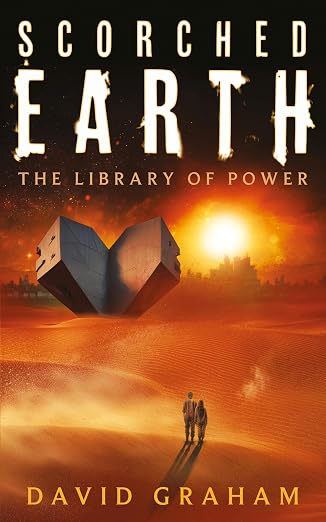
I've always believed that the most terrifying dystopias aren't the stories about broken worlds, but the stories about broken humanity. The stories that make us question what it even means to be human. For example, imagine the ultimate dystopian question: when the planet is dying, the oceans are lost to space, and few of us remain, what is more important—our survival, or our humanity? Imagine trying to answer that question, and the danger it would pose in having the debate. Imagine how it could lead to exposing a darkness within us, and imagine asking the question: can we rise above that darkness? I invite you into Elizabetha, which is the place that will explore that question. It is the last city on Earth—a subterranean, windowless fortress of 50,000 souls surrounded by endless, blistering sands where daytime temperatures surpass 100°C. In Elizabetha, survival requires absolute conformity. Citizens wear white jumpsuits, carry badges marking their societal roles over their hearts, and are strictly banned from forming human connections. To feel is a crime punishable by death. In the world that we live in, I think many will find that relatable, as it is so easy to get lost in the desire to stand alone that it's easy to forget that we do need people. I forgot that. Due to long-standing hand and wrist injuries, I cannot use a computer keyboard, and I'm gonna be honest, for a very long time, that reality broke me. I tried to stand alone, tried not to need people, tried to function as normal, to be normal. But all the while, I also questioned what a broken-bodied person with limited use of his hands could really contribute to the world. After all, how do you even function in the modern world when you can't use a computer, let alone write a book? The answer came when I stopped trying to type and started speaking. I started asking for help, and when I started doing that, I started finding ways forward. I wrote this entire book hands-free. Yep, I wrote it using voice dictation software. Dictating this epic adventure into reality freed me from my pain and gave me a new life, a life as a writer. That was my motivation for writing this book. My inspiration. I wrote it to prove that you don't need functioning hands to write a book, you just need to be willing to accept that you are human, and the most human thing in the world is to need others. Hopefully Josephine's story captures that feeling. I truly believe it does.
If you had to pick theme songs for the main characters of your book, what would they be? (Meant to be fun. Skip if you need to!)
Josephine and Charlene wouldn't know what music is, but Jacob would. Jacob is a real hard worker and a good, honourable man, but he also has a playful side to him, and probably in another life would have fancied himself as a bit of a Jack the Lad. If he was going to pick a theme for himself, it would be something playfully motivating. The kind of music that a group of self-deprecating but battle-hardened soldiers would listen to to give themselves a lift before going into battle, so the kind that would pump them up but also put a smile on their faces. Because, you know, they got this.
What's your favorite genre to read? Is it the same as your favorite genre to write?
My favourite genres are without a doubt science fiction, fantasy, and thriller. I love writing these genres; I love reading these genres. True inspirational writers to me are people like Isaac Asimov, Robert Ludlum, Frank Herbert, JRR Tolkien, George Orwell, Aldous Huxley, and the list goes on. I'm a big lover of classic fiction, and especially love writers who ask difficult questions and create brilliant stories by trying to answer them. That's why I'm also a fan of nonfiction, and I love history and science books, especially the kind that help you see the world in a different light. So actually, I guess that makes my favourite genre to read and write the kind that helps you gain a new perspective on the world and the people in it.
What books are on your TBR pile right now?
Klara and the Sun by Kazuo Ishiguro. A few people who have reviewed my book, Scorched Earth: The Library of Power, have said that it's their favourite dystopian book since Klara and the Sun. This has made me very curious to read the story, and based on the blurb and the ridiculous number of positive reviews, I'm very much looking forward to giving it a read. The other book at the top of my reading list is Artemis by Andy Weir. I'm a big fan of Andy Weir, and absolutely loved The Martian and Project Hail Mary, but for some reason I've never read Artemis. I'm planning on changing that very soon.
What scene in your book was your favorite to write?
I would probably say either the moment Josephine finally learns what "kindness" means, and that is not a typo, what "kidness" means. Either that scene or the ending, though I won't give any hints about that. No spoilers here. All I'll say is the scenes were so powerful to write and experience. They really brought the story together and just gave it that extra dimension, the kind that leaves a lasting mark because they are so human.
Do you have any quirky writing habits? (lucky mugs, cats on laps, etc.)
Writing with voice dictation software is probably a quirky habit, though I didn't make that transition by choice. I do like to be stood up when I'm writing. I don't know if that's because I'm a fidget and like to move while I'm thinking, or what, but it's certainly a quirk. I often wonder what people would think seeing me standing in front of the computer, pacing about, while narrating a novel, especially as I tend to put on a voice for the characters.
Do you have a motto, quote or philosophy you live by?
If I say I'm going to do something, I do it. That is my belief, that is my motto, that is what I live by. After all, there is no point saying you are going to do something, and then not doing it. It's just a waste of breath, a waste of thought. Worse, if you become a person who does not follow through on what you say, you become a person whose words and so voice are worthless. I refuse to ever be such a person, and though this motto does sometimes come back to bite me, like when I tell a family member I will fix a problem I don't have time to fix, it is the motto that helped me write this book.
If you could choose one thing for readers to remember after reading your book, what would it be?
That it's okay to need people, that it's okay to be human, and that what it means to be human is different for everybody, and that's okay.
David Graham is the author of the new book Scorched Earth: The Library of Power
Connect with David Graham