
What's the story behind the story? What inspired you to write this book?
Uh. The true answer to this question could fill an entire book on its own. Still, I'll try to answer. My earliest memory goes back to when I was four years old. It is the only thing I remember from that age: a winter evening, the crackling of an open fire, and my grandfather telling me an ancient story in his own unforgettable way. Even now, decades later, I can still recall the colors of the flames, the smell of burning wood, the shadows on the walls, and the sound of his voice. Then life moved on. I grew up, my grandfather passed away, and eventually I found myself living through the chaos of war. And then something happened that changed everything. During one quiet moment in the middle of that darkness, I opened a book almost by accident — and suddenly I was staring at the very same story my grandfather had told me all those years before. It hit me like lightning. Every buried memory came rushing back at once. From that moment on, I could never let the story go. For the next twenty-three years, I lived with it. I studied every line obsessively, traveled to locations where the events may once have unfolded, and even learned the original language in which the text was first written.
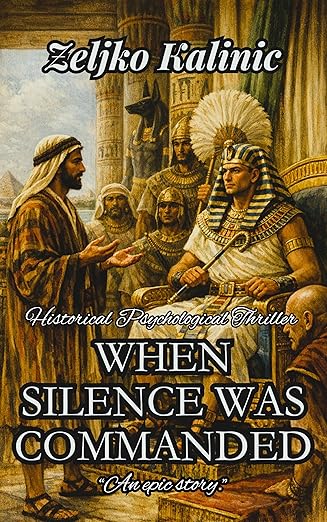
Yet despite all that time, the story still guarded a secret from me — until one day, unexpectedly, something hidden inside it revealed itself. A detail I had overlooked for more than two decades suddenly changed everything I thought I knew. That discovery became the foundation of my first book, published in 2016, where I explored how the text works beneath the surface and why nothing in the story is truly what it first appears to be. But although I believed deeply in what I had uncovered, the book passed almost unnoticed. For a while, that disappointment stayed with me. Then, two years ago, another idea emerged: what if this ancient story — with all its hidden layers, psychological tension, and human darkness — was retold as a psychological thriller? That single thought unlocked the book you are holding now. It took me nearly two years to write it, but this time I approached the story differently — not only as a researcher, but as a storyteller. Before publishing it, I shared it with friends and trusted readers, and their reactions surprised even me. The same story that has haunted, fascinated, and inspired me for most of my life suddenly began captivating others in exactly the same way. And perhaps that is the greatest inspiration behind this book: the strange realization that some stories never truly leave us. They wait patiently in the shadows, until the moment they are finally ready to reveal what they have been hiding all along.
If you had to pick theme songs for the main characters of your book, what would they be?
Because the book moves through several emotionally charged worlds, choosing only one theme song would feel almost impossible. Each major character carries a different wound, hope, fear, or silence within them — and each of those emotions seems to demand its own soundtrack. The songs that resonate with the spirit of the story most deeply would probably be “The Sound of Silence” by Simon & Garfunkel, “Hurt” by Johnny Cash, “How to Save a Life” by The Fray, “Bad Blood” by Taylor Swift, and “Running Up That Hill” by Kate Bush. Together, those songs create an emotional map of the novel itself — silence, pain, betrayal, longing, sacrifice, and the desperate human need to be understood.
What's your favorite genre to read? Is it the same as your favorite genre to write?
I don’t believe in limiting myself to a single genre. As a reader, I’m drawn to stories that linger long after the final page—stories that challenge me to think deeper about life, human behavior, and the invisible forces that move individuals, nations, and humanity itself. Whether it’s psychological drama, historical fiction, thriller, or something entirely unexpected, I read anything that sparks reflection and reveals uncomfortable truths beneath the surface. The same applies to my writing. I never want to be confined by genre boundaries. Each book may wear a different face, but beneath every story runs the same pulse: an exploration of the human condition, of hidden motivations, emotional fractures, moral dilemmas, and the quiet tensions that shape our lives. No matter the setting or style, those themes are always there—waiting beneath the surface for the reader to uncover them.
What books are on your TBR pile right now?
My TBR pile isn’t stacked with novels at the moment—it’s divided between two obsessions that seem completely different on the surface, yet strangely connected underneath: religious mysticism and international negotiation. One explores the hidden movements of the soul; the other dissects the hidden movements of power, language, and human intention. Lately, those subjects have consumed most of my reading hours. And whatever little time remains is being swallowed by two new manuscripts I’m currently working on—texts I hope will eventually grow into books of their own. In a way, my TBR pile has become less of a stack of books and more of a battlefield of ideas waiting to find their way onto the page.
What scene in your book was your favorite to write?
My favorite scene to write was the moment when a long-buried truth finally begins to emerge from the silence that has concealed it for generations. Without revealing spoilers, it is a scene where tension, fear, guilt, and destiny collide. The characters stand at the edge of a revelation that has been building throughout the entire story, and the emotional weight of that moment was incredibly rewarding to write. I loved exploring not only what the characters discovered, but how those discoveries transformed them from within. What made the scene especially fascinating was the contrast between silence and truth—the central theme of the novel. For much of the story, secrets remain hidden beneath the surface, shaping lives in ways the characters do not fully understand. Writing the moment when those hidden realities begin to break through felt like watching a curtain slowly lift after thousands of years.
Do you have any quirky writing habits? (lucky mugs, cats on laps, etc.)
I wish I could say I’m one of those writers who can only work with a particular mug, a storm outside the window, or some strange ritual like tying red thread around my toes for inspiration. But the truth is far less theatrical. I don’t really have quirky habits—at least none that I’m aware of. What I do need, however, is solitude and silence. The moment the room grows still, and the world quiets down, that’s when the stories begin to speak the loudest.
Do you have a motto, quote or philosophy you live by?
I do have a philosophy I return to often, though it feels less like a quote and more like a compass for surviving both life and myself: Look forward with hope, look back with gratitude, look up with prayer, look down with repentance, look inward with attention! And around - with love! Because once you truly begin looking at the world through love, you realize something unsettling and beautiful at once: life becomes impossible not to love. I also believe human beings are made of contradictions that must learn to coexist. The one who loves must eventually learn fear. The fearful must learn love. The thinker must act. The doer must stop and think. The pacifist must know when to fight, and the fighter must someday discover peace. People often choose between fire and river — between passion and calm, destruction and surrender. But I think the real challenge is becoming both at once: a fire that flows. Love with fear and fear with love. To burn without consuming yourself. To move forward without losing your soul.
If you could choose one thing for readers to remember after reading your book, what would it be?
I already know the answer to that. Readers won’t remember this book merely for its events—they’ll remember how deeply it made them feel. These characters may be separated from us by more than 3,500 years, yet their emotions feel disturbingly modern. Betrayal that cuts like a blade. Jealousy that quietly poisons love. Guilt that refuses to stay buried. The haunting pull of destiny. And, perhaps most powerfully, the fragile possibility of reconciliation after devastation. Readers will realize that time changes languages, kingdoms, and customs—but never the human heart. The emotions in this story do not whisper from the pages; they burn through them.