

What's the story behind the story? What inspired you to write 1953 - The Shadow of Tunguska?
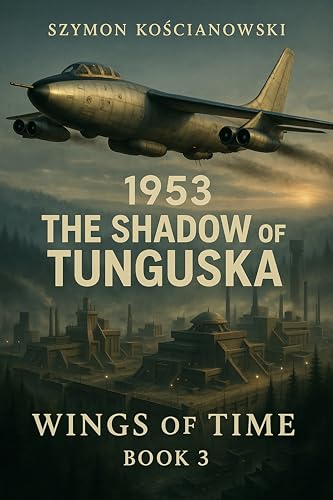
The story behind this book comes from my fascination with alternate versions of our own timeline – the endless “what if…?” scenarios. What if one decision, one discovery, or one unexplained event had gone differently? 1953 – The Shadow of Tunguska grew out of that curiosity: taking real history and a real mystery, and then nudging them just enough to open a completely different path for our world. The deeper inspiration to start writing seriously, though, came from my younger son. When he was 13, he began writing and publishing his own science fiction stories. And they weren’t “kids’ stories” – they were surprisingly mature, the kind of work I could comfortably compare to early Lem, Clarke, or Asimov in their twenties and thirties. Watching him be so fearless and dedicated to storytelling made me realize I had no excuse. If he could sit down and build worlds from scratch, then it was time for me to finally do the same.
If you had to pick theme songs for the main characters of 1953 - The Shadow of Tunguska, what would they be?
If I had to pick theme songs for the main characters, I’d choose three classics.
“The Sound of Silence” by Simon & Garfunkel fits the character who carries the heaviest secrets – someone surrounded by noise and yet profoundly alone with what they know.
“For What It’s Worth” by Buffalo Springfield captures the growing sense of tension and paranoia as the political and military stakes rise, and nobody is sure who is really pulling the strings.
And “Stairway to Heaven” by Led Zeppelin reflects the more spiritual, almost mythical side of the story – the idea that what happened at Tunguska might be part of a much larger journey that reaches far beyond 1953.
What's your favorite genre to read? Is it the same as your favorite genre to write?
I gravitate toward alternate history, technothrillers, and hard science fiction. I love stories that ask “what if this one detail of history or technology had gone differently?” and then follow the logic all the way through. It is very much the same with my writing – the Wings of Time series sits exactly at that intersection, where real history and real science are pushed just far enough to open a new timeline.
What books are on your TBR pile right now?
My TBR pile is dangerously tall at the moment. I’m working my way through Isaac Asimov’s Foundation and Empire series, and Dan Jones’s The Templars. I also have Liu Cixin’s The Three-Body Problem trilogy lined up, and a whole stack of Michio Kaku’s books, including The Future of Humanity, Physics of the Impossible, Hyperspace, Parallel Worlds, The God Equation, and Quantum Supremacy. And because I love a good Cold War-era thriller, Tom Clancy’s The Sum of All Fears is sitting there too, waiting for its turn.
What scene in your book was your favorite to write?
My favorite scenes to write are always the ones that involve some kind of clash – in the air, at sea, or under the surface. In this book, the one that stands out most for me is the battle between a US submarine and a Soviet frigate. It’s a duel where almost nothing is visible, and everything depends on sound, intuition, and nerve. I loved writing the cat-and-mouse tension: the crew listening to the ocean, trying to decide whether the faint noise in their headphones means survival or disaster, while the Soviet ship hunts something it can’t see. It’s not just about torpedoes and depth charges; it’s about fear, responsibility, and the split-second decisions that can change history.
Do you have any quirky writing habits? (lucky mugs, cats on laps, etc.)
I don’t really have any lucky mugs or cats supervising my keyboard. What I do have is a slightly destructive relationship with inspiration. When it hits, it doesn’t matter if it’s 2 a.m. – I get up and write until I drop. So my only real “quirk” is that I let the story set the schedule. If a scene starts unspooling in my head, I follow it, no matter what the clock says. Sleep can wait; the ideas usually don’t.
Do you have a motto, quote, or philosophy you live by?
I’d say I live by two simple ideas. First: “Don’t follow the rules – make them.” I like stories, careers, and lives that don’t fit neatly into someone else’s template. Second: a line I really believe in – “You are never too old to set a new goal or to dream a new dream.” For me, writing is proof of that. It’s never “too late” to start a book, a series, or a completely new chapter in life.
If you could choose one thing for readers to remember after reading your book, what would it be?
If I could choose one thing for readers to remember, it would be the feeling of adrenaline they had while following the story. I hope they feel as if they were right there in the cockpit, on the deck, or in the control room – making impossible decisions under pressure, with history hanging in the balance. If that tension and excitement stay with them after they turn the last page, then I’ve done my job.
Szymon Kościanowski is the author of the new book 1953 - The Shadow of Tunguska
Connect with Szymon Kościanowski
Sign up for our email and we’ll send you the best new books in your favorite genres weekly.