
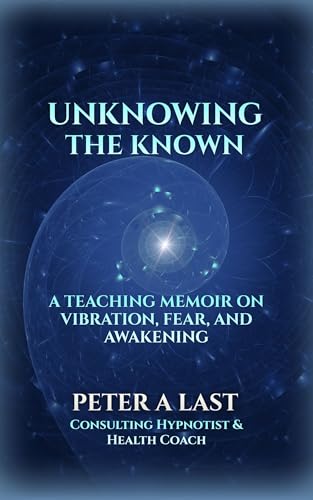
What's the story behind the story? What inspired you to write Unknowing the Known?
Unknowing the Known didn’t show up as just another book idea — it arrived as a turning point. For years, I lived by stories that weren’t mine: expectations, roles, beliefs about what it meant to be “enough,” especially as a man. I survived by staying busy, staying strong, and staying disconnected from the parts of myself I didn’t want to face. But eventually, the old stories started to collapse. The identity I built didn’t hold anymore. And life pushed me straight into the shadows — into fear, doubt, and the uncomfortable truth I could no longer outrun.
That breaking point — that descent into the darkness — is what sparked this book. And yet, it didn’t come out of nowhere. I’ve written numerous books on shadow work, healing, and awakening. I’ve studied teachers, coaches, philosophers, and gurus. I’ve created systems, challenges, frameworks — all driven by passion, curiosity, and creativity. But the deeper truth is this: every book I wrote before this one was preparing me for this book. Those books were my teachers. This one is my truth. This time, I wasn’t writing from theory. I wasn’t writing from what I’d learned. I was writing from what I lived.
When I questioned the “known,” I uncovered a level of authenticity I had never reached before. When I peeled back the fear programming, the vibration shifts, the inner child wounds — I found the real story: the journey of unlearning everything that wasn’t mine, and remembering everything that was.
Unknowing the Known is a teaching memoir because it carries both sides of the process — the raw story of my own awakening and the tools that helped me rebuild from the inside out. It’s the book I wish I had when my life cracked open. It’s the book I needed when I was in the dark. And it’s the one that finally felt like it came from my soul instead of my mind.
If someone reads this and realizes, “I’m not breaking — I’m awakening,” then everything I lived through was worth it.
If you had to pick theme songs for the main characters of Unknowing the Known, what would they be?
“Unstoppable” – Sia
What's your favorite genre to read? Is it the same as your favorite genre to write?
I’ve always been drawn to books that mix depth with practicality — the kind that crack you open and help you put yourself back together in a way that actually makes sense in real life. So my favorite genre to read is anything rooted in personal evolution, whether it’s psychology, spirituality, shadow work, or a memoir that tells the truth without sugarcoating it. But I also gravitate toward authors who bring common sense into the conversation — the ones who don’t float off into the clouds, who take big ideas — vibration, fear, healing, awakening — and make them usable in the real world. That’s the kind of writing that sticks with me.
When it comes to writing, I stay in that same lane… just more personal. I write where memoir meets teaching, where lived experience becomes a guide for someone else’s breakthrough. It’s not pure self-help, not pure story — it’s that middle ground of honesty, reflection, and practical tools. And for me, common sense is the bridge. It keeps the message grounded, relatable, and human.
Here’s the truth: I didn’t always write like this. I wrote around my story for years — books on shadow work, healing, inner child work — all useful, all meaningful. But looking back, I can see that every book I wrote before this one was just preparing me. They were stepping stones. This book? This is the one that feels like mine. This is where my experience, my common sense, and my awakening finally met in the same place.
So yes, I read what I write… but now, I write it with clarity, courage, and a whole lot of common sense.
What books are on your TBR pile right now?
Right now, my TBR pile is a mix of psychology, consciousness, and the kind of books that push me deeper into the work I’m already exploring — especially when it comes to vibration, frequency, and human transformation. At the top of the list is Carl Jung’s work, especially the writings on individuation, the unconscious, and the alchemical stages like the Nigredo. His ability to map the inner world with such clarity still blows my mind, and every time I revisit him, I discover something new about myself and about humanity. I’m also diving into books that explore the science behind frequency and human energy, because the more I understand vibration from both a spiritual and common-sense perspective, the deeper my own work becomes. Books on quantum awareness, consciousness studies, and vibrational psychology are always in rotation for me. And honestly? I keep a permanent spot on my TBR for my own upcoming release, Unknowing the Known, not because I haven’t read it — obviously — but because every time I go back through it, I’m reminded of how far this journey has taken me. It’s the bridge between everything I’ve studied, everything I’ve lived, and everything I’ve let go of.
What scene in your book was your favorite to write?
The moment I found most powerful to write was the one where I realized — fully, unmistakably — that I was in the Nigredo, the first stage in Carl Jung’s alchemical process of transformation. It’s the phase where everything familiar dissolves, where the old self breaks apart, and where you’re forced to face the truth you’ve buried under years of survival, fear, and conditioning.
Most people think awakening feels like light. It doesn’t. It starts in the dark. In that moment, everything in my life felt like it had collapsed at once — the identity I held onto, the beliefs I’d inherited, the stories I repeated because they felt safer than the truth. And instead of running, distracting myself, or trying to “fix” it, I finally let myself sit in that darkness long enough to hear what it was trying to tell me. That was the moment where I understood: I wasn’t breaking down — I was breaking open. I wasn’t lost — I was shedding.
Writing that moment was powerful because it captured the exact point where fear and awareness collided. It was the beginning of “unknowing” the old narrative, letting the ego’s voice crack, and allowing a new, quieter truth to rise. It was the first time I wrote from pure lived experience, not borrowed wisdom. All the books I’d written before — on shadow work, healing, transformation — were stepping stones leading me here. They were teachers. But this moment? This one was mine. This was the moment everything finally clicked. And putting it on the page felt like honoring the man I used to be, the man I was becoming, and the man I finally allowed myself to meet.
Do you have any quirky writing habits? (lucky mugs, cats on laps, etc.)
Absolutely — I’m a proud member of the “4 A.M. Writers Club.” There’s something about that hour when the world is silent, the mind is clear, and creativity slips in without knocking. That’s when my ideas come through the loudest — raw, honest, and unfiltered. And I’m never alone. My co-author, Tucker, a very opinionated orange tabby, claims the spot beside me every morning. She doesn’t write a word, but she purrs like she’s editing my thoughts in real time. There’s a rhythm to it — me typing, her purring — and somehow it keeps me grounded. It’s like she knows when I’m onto something and when I’m avoiding the truth. Most people need coffee. Apparently, I just need complete silence, a blank page, and a cat who thinks she’s on the payroll. It’s quirky, but it works — and honestly, those early hours with Tucker are where some of my best insights and breakthroughs are born.
Do you have a motto, quote, or philosophy you live by?
Yes — and it’s the foundation of my life and my work: “What you perceive to believe as truth becomes your reality.” For most of my life, I didn’t realize how deeply my beliefs were shaping my world — the fears I carried, the limits I accepted, the stories I repeated because I thought they were facts. But once I started questioning those beliefs, everything shifted. I realized that perception isn’t just a lens — it’s a creator. It determines how we see ourselves, how we interpret our past, and what we believe is possible for our future.
The moment you change what you perceive as truth, you change the direction of your entire life. This philosophy is woven through Unknowing the Known — because healing, awakening, and shadow work all start with one simple awareness: You can’t transform what you’re still calling “truth.” But the moment you challenge it? You open a door into a new reality — one built from clarity, courage, and common sense instead of fear. That’s the motto I live by, write by, and teach from.
If you could choose one thing for readers to remember after reading your book, what would it be?
I want readers to walk away knowing one simple truth: They’re already awakened — they’ve just been buried under generations of borrowed beliefs. So many of the fears we carry, the doubts we repeat, and the stories we live by… they’re not even ours. They were inherited, absorbed, or handed down by people who were doing the best they could with the awareness they had. And somewhere along the way, we mistook those beliefs for truth.
If there’s one thing I hope readers remember, it’s that awakening isn’t about becoming someone new — it’s about remembering who you were before the world told you who to be. You’re already present. You’re already aware. You’re already connected. You just haven’t been taught to trust it. And when you finally realize that the beliefs that shaped you aren’t permanent, personal, or even accurate… you’re free to let them go. If readers take anything from this book, I hope it’s the quiet confidence of knowing: “This is my life, my truth, and I get to choose what stays and what no longer belongs.”
Sign up for our email and we’ll send you the best new books in your favorite genres weekly.