
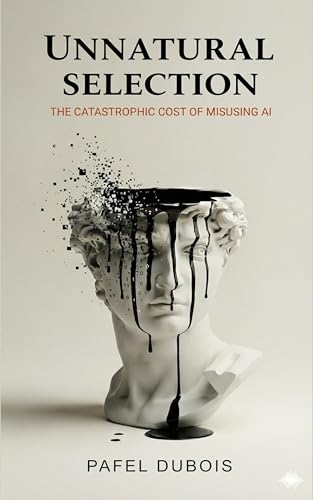
What's the story behind the story? What inspired you to write Unnatural Selection: The Catastrophic Cost of Misusing AI?
The inspiration came from a place of observation and necessary warning. With my background in International Business, I have spent years analyzing how complex systems operate and fail. When the current wave of generative AI arrived, I noticed a disturbing trend in the corporate world: companies weren't using these tools to enhance human capability; they were using them to delete the human element entirely. I realized we were sleepwalking into a massive "brain drain" where we surrender our critical thinking and operational resilience to algorithms we barely understand. I wrote this book not to be anti-technology, but to be pro-humanity. I wanted to map out exactly what we lose when we choose convenience over competence, and how we can stop that slide before the cost becomes catastrophic.
If you had to pick theme songs for the main characters of Unnatural Selection: The Catastrophic Cost of Misusing AI, what would they be?
Since this is non-fiction, my "characters" are concepts, but they certainly drive the narrative:
• For the Villain (Unchecked AI Integration): "Radioactive" by Imagine Dragons. It feels powerful, systemic, and dangerous if not contained.
• For the Hero (Human Critical Thinking): "Under Pressure" by Queen and David Bowie. It represents the immense stress we are under to compete, but also the undeniable beauty of human resilience and collaboration.
• For the Resolution: "Human" by Rag'n'Bone Man. It serves as a gritty reminder that our imperfections and our ability to feel are actually what make us valuable.
What's your favorite genre to read? Is it the same as your favorite genre to write?
I am a contradiction in this regard. While Unnatural Selection is serious non-fiction, I rarely stay in that lane as a reader. I have a deep love for science fiction because it allows us to simulate future ethical dilemmas, and I enjoy upmarket romance because it explores the complexities of human emotion—something AI cannot replicate. I find that reading fiction makes me a better non-fiction writer because it teaches me how to tell a story and maintain a narrative arc, rather than just lecturing the reader with data.
What books are on your TBR pile right now?
My "To Be Read" pile is actually a "To Be Listened To" queue. I am a huge proponent of audiobooks because they allow me to consume complex information efficiently while I am moving. Currently, I am listening to Co-Intelligence by Ethan Mollick to analyze the AI debate from a different angle. I also keep a few classic French novels in the rotation to reset my brain—listening in my native language helps me decompress after a long day of working in English.
What scene in your book was your favorite to write?
In non-fiction, we don't have scenes so much as breakthroughs. My favorite section to write was the chapter on "The Human Moat." Up until that point in the book, I spent a lot of time outlining the catastrophic risks. But "The Human Moat" is the pivot where I explain why humans remain relevant. It felt necessary to stop diagnosing the illness and finally write the prescription. Writing about empathy, nuance, and intuition—skills machines cannot authentically replicate—felt like a reclamation of our value.
Do you have any quirky writing habits? (lucky mugs, cats on laps, etc.)
I am probably the only writer I know who absolutely hates coffee, so I function entirely without caffeine. My "office" is also unconventional; my best inspiration usually hits me in the shower. There is something about the isolation that puts me in a creative trance where plot holes just seem to fix themselves. To clear my head, I love hiking, but I avoid popular trails. I have a touch of claustrophobia regarding big crowds, so I need open, solitary spaces to really recharge.
Do you have a motto, quote, or philosophy you live by?
"We are what we repeatedly do. Excellence, then, is not an act, but a habit." This quote, attributed to Aristotle, is the core philosophy of my life and this book. If we repeatedly outsource our thinking to AI, we lose the habit of excellence. We become what we do, so I try to ensure that what I am doing is deliberate and human.
If you could choose one thing for readers to remember after reading your book, what would it be?
I want them to remember that they have agency. The future isn't something that happens to us; it is something we build. You can use AI to handle the drudgery so you have more time to be creative, or you can let it replace your creativity. I want readers to close the book feeling empowered to set boundaries with technology, rather than feeling inevitable defeat.
Pafel Dubois is the author of the new book Unnatural Selection: The Catastrophic Cost of Misusing AI
Connect with Pafel Dubois
Sign up for our email and we’ll send you the best new books in your favorite genres weekly.