

What's the story behind the story? What inspired you to write Sanctuary Row?
In early 2025, I was given an unexpected early retirement after decades in a soul-crushing government job. Suddenly untethered—no daily grind, grown kids, no real ties—I did what I’d fantasized about for years: I liquidated everything, flew to Thailand alone, and started rebuilding a quieter life far from everything I’d known.
But freedom came with a brutal catch. Routine medical tests in Bangkok revealed early-onset frontotemporal dementia. At 55, I was handed a timeline: a few good years at best before I’d need full-time care. The diagnosis hit like a second life sentence—this time, one I couldn’t escape.
Sitting in that small farmhouse outside Chiang Mai, with a rescued cat on my lap and an old typewriter I’d bought on impulse, I started writing—not to publish, but to preserve whatever memories I could before they slipped away. I needed my kids (and honestly, myself) to understand why I’d been such a distant, flawed father. Why I’d always lived in my head. Why were certain parts of my past locked away?
The more I typed, the more the past poured out: the childhood violence, the fleeting moments of joy (that summer working at Sanctuary Row in Phoenix felt like the peak of my entire life), the reckless freedom of my teens and twenties, the relationships that burned bright and crashed hard, and the quiet regrets that followed me across oceans.
What began as a private catharsis turned into this book. The fictional frame—Evelyn, Marcus, Lila—gave me distance to explore the raw truth without exposing everything literally. But make no mistake: the emotional core is mine. The ache of second chances arriving too late, the terror of losing your own mind, the desperate need to finally be seen and forgiven—these are the scars I carried into that farmhouse.
I wrote Sanctuary Row because I was running out of time to explain myself. Because some stories demand to be told before the fog closes in. And because, even facing the end, I still believe in redemption—if not for me, then maybe for the people who read it and recognize pieces of their own unfinished lives. It’s not just a novel. It’s the closest thing I’ll ever have to leaving a clear footprint before the tide washes it away.
If you had to pick theme songs for the main characters of Sanctuary Row, what would they be?
The Narrator / Lamar (the older man writing his life story from Thailand) –
“The Great Pretender” by The Platters (1955 version)
Young Lamar / Joe (the teenage/young adult version living his “peak freedom” days) –
Mötley Crüe’s “Shout at the Devil” era, specifically “Too Fast for Love.”
Anna (the young nurse and care partner) –
“Angel” by Sarah McLachlan
Tansy (the chaotic force that derails everything) –
“Tainted Love” by Soft Cell
Bonus: The overall mood of Sanctuary Row (the store and that golden summer) –
“Summer of ’69” by Bryan Adams
What's your favorite genre to read? Is it the same as your favorite genre to write?
My favorite genre to read is literary fiction with a psychological edge—stories that dig deep into flawed, complicated people wrestling with regret, identity, trauma, and the quiet ways we try (or fail) to redeem ourselves. Think authors like Kent Haruf, Alice Munro, Richard Russo, or Annie Proulx—slow-burn character studies set in small towns or isolated lives, where nothing explosive happens on the surface, but everything is unraveling or rebuilding underneath. I also love a touch of darkness: Kent Haruf’s Plainsong trilogy or Stewart O’Nan’s quieter books hit that sweet spot for me. When it comes to writing, it’s the same territory. I’m drawn to the same emotional terrain—midlife reckoning, fractured families, second chances that arrive too late, the weight of unspoken history. I don’t write fast-paced thrillers or high fantasy (I admire them, but they’re not where my voice lives). My stories tend to be introspective, raw, and relationship-driven, often with mature themes because that’s the lens I know best: love, loss, and healing (or the lack of it) when you’re old enough to see the patterns you can’t escape.
So yes—reading and writing line up perfectly for me. I write the kind of books I most want to read: honest, character-deep stories about ordinary people carrying extraordinary wounds, searching for some small measure of grace before the lights go out.
What books are on your TBR pile right now?
Demon Copperhead by Barbara Kingsolver – I’ve been meaning to read this forever. The modern David Copperfield retelling set in Appalachia with addiction and poverty at its core feels like it’ll wreck me in the best way. The Road to Dalton by Shannon Bowring – A small-town Maine interconnected story collection. I loved her debut, Where the Forest Meets the River, and this one promises more of that gentle-but-devastating slice-of-life depth. James by Percival Everett – His reimagining of Huckleberry Finn from Jim’s perspective. I’m a huge Everett fan (Erasure and The Trees blew me away), and this one keeps popping up on every “best of 2024/2025” list. Small Things Like These by Claire Keegan – Short, spare, and emotionally brutal. I’ve heard it’s the kind of novella that punches way above its weight on regret, morality, and quiet courage. The Heaven & Earth Grocery Store by James McBride – Still haven’t gotten to this one, even though everyone raves about the characters and the layered community story. Feels like perfect winter reading. Foster by Claire Keegan (reread) – I go back to this tiny masterpiece every couple of years. It’s only 90 pages, but it captures childhood grief and fleeting kindness better than most 500-page novels. I tend to read these days slowly—savoring, underlining, letting the stories sit with me—so the pile doesn’t move as fast as it used to. But these are the ones I’m genuinely excited to dive into next.
What scene in your book was your favorite to write?
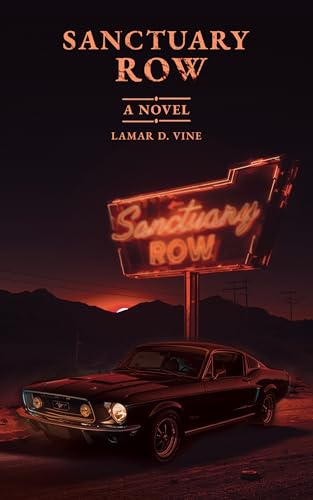
My absolute favorite scene to write in Sanctuary Row was the long, sun-drenched opening stretch of the “Peak Freedom” chapter—the one that begins with the narrator driving his Poppy Red ’65 Mustang down Bethany Home Road on a crispy summer morning in 1988, Mötley Crüe blasting, pulling into the back lot of Sanctuary Row for his Sunday shift. I loved writing it because it was the one moment in the entire book where life felt perfect—no regrets yet, no noose tightening, just pure, electric freedom. The smell of incense hits you as you walk in, the ritual of the Big Gulp run to 7-Eleven, chopping that little line of coke in the darkened office, turning the stereo up loud enough to drown out the world… every sensory detail poured out of me like I was living it again. It was effortless. Pages flew by. I could feel the Arizona heat rising off the asphalt, hear the door slam on the Mustang, taste the numbness in the back of the throat. That whole sequence—maybe 2,000–3,000 words of just lingering in the best summer of his life—was pure joy to write because I knew it couldn’t last. I got to give the narrator (and myself) one long, slow inhale of happiness before everything started closing in. It’s the scene I go back and reread when I need to remember why I wrote the book in the first place: to preserve that fleeting feeling of being young, untethered, and convinced the good times would never end—even when some part of you already knows they will.
Do you have any quirky writing habits? (lucky mugs, cats on laps, etc.)
The lime-green Remington typewriter: Even though most of the drafting happens on a laptop these days, I still drag out my second-hand Remington for certain scenes—especially the raw, confessional parts. There’s something about the physical clack of the keys and the permanence of no backspace that forces me to think harder before I commit. Mistakes get crossed out with XXXXXs, and I kind of love the mess—it feels honest. Cat on lap (or keyboard blockade): Zeko, my little black-and-white rescue cat, is a non-negotiable writing companion. He plants himself right on my chest or sprawls across the keyboard whenever he senses I’m getting too deep into a heavy memory. I’ve learned to interpret it as “take a break, human.” Half my chapters have random strings of letters from his paws walking across the keys. I leave them in the draft as little paw-print signatures. Midnight joint on the back porch: When I hit a wall or the memories get too dark, I step outside for a smoke under the stars. The cool night air and the quiet of rural Thailand reset me. A lot of the reflective passages—especially the ones looking back on Sanctuary Row—came together out there, watching fireflies and listening to geckos. Same battered coffee mug: It’s an old, chipped enamel mug I picked up in a Chiang Mai market—faded blue with a tiny crack on the rim. I only drink coffee from it when I’m writing. If it’s in the sink, I’ll wash it by hand before I sit down. No idea why, but switching mugs feels like bad luck. Silence or very specific music: Total quiet for dialogue-heavy scenes, but when I’m deep in the nostalgic Sanctuary Row sections, it’s gotta be ’80s hair metal or classic rock turned up just loud enough to feel the bass—reminds me of blasting Mötley Crüe in that Mustang. These little rituals are my way of tricking myself into showing up at the page, especially on days when the story feels too heavy to carry. They’ve become my lucky charms.
Do you have a motto, quote, or philosophy you live by?
Yes—I do, and it’s evolved over the years, especially after the diagnosis forced me to stare down how little time any of us really have. My guiding philosophy now is simple but hard-won: “Tell the truth while you still can—especially to yourself.” For most of my life, I was the great pretender: keeping painful memories locked away, staying quiet to protect fragile relationships, living in my head instead of out loud. I told myself it was easier that way—less conflict, less vulnerability. But silence has a cost. It lets wounds fester, misunderstandings calcify, and regrets pile up until they’re too heavy to carry. When I got the news in Bangkok that my memories would start slipping away, the urgency hit me like a freight train. I realized the one thing worse than facing the ugly truths of my past would be losing the chance to face them at all. So I started writing—raw, unfiltered, no more pretending. Not to justify myself, but to finally own my story before the fog took it from me. That’s what I live by now: Speak your truth, share your scars, ask for forgiveness (or offer it) while there’s still time. Life is too short—and memory too fragile—for anything less. It’s not always comfortable, but it’s the closest thing to peace I’ve found.
If you could choose one thing for readers to remember after reading your book, what would it be?
It’s never too late to tell the truth—and it’s never too late to forgive, even if the only person you’re forgiving is yourself. So many of us spend years (decades, even) pretending the painful parts of our story didn’t happen, or didn’t matter, or weren’t our fault. We lock them away to keep the peace, to protect others, or to protect ourselves from having to feel them again. But those unspoken truths don’t stay buried—they shape us, push people away, and quietly steal the years we have left. The narrator spends his whole life running from his past, only to face it head-on when a diagnosis tells him the clock is running out. And in that final stretch, he discovers something brutally simple: speaking the truth—out loud, on the page, to the people who need to hear it—is the closest thing to redemption most of us will ever get. I hope readers close the book feeling a little braver about their own unfinished conversations, their own regrets, their own need to be seen for who they really are—scars and all. Because as long as you still have time, you still have a chance to make peace with your story. That’s the heartbeat of the book for me. I’d be honored if even one reader walked away thinking, Maybe I should finally say that thing I’ve been carrying.
Sign up for our email and we’ll send you the best new books in your favorite genres weekly.