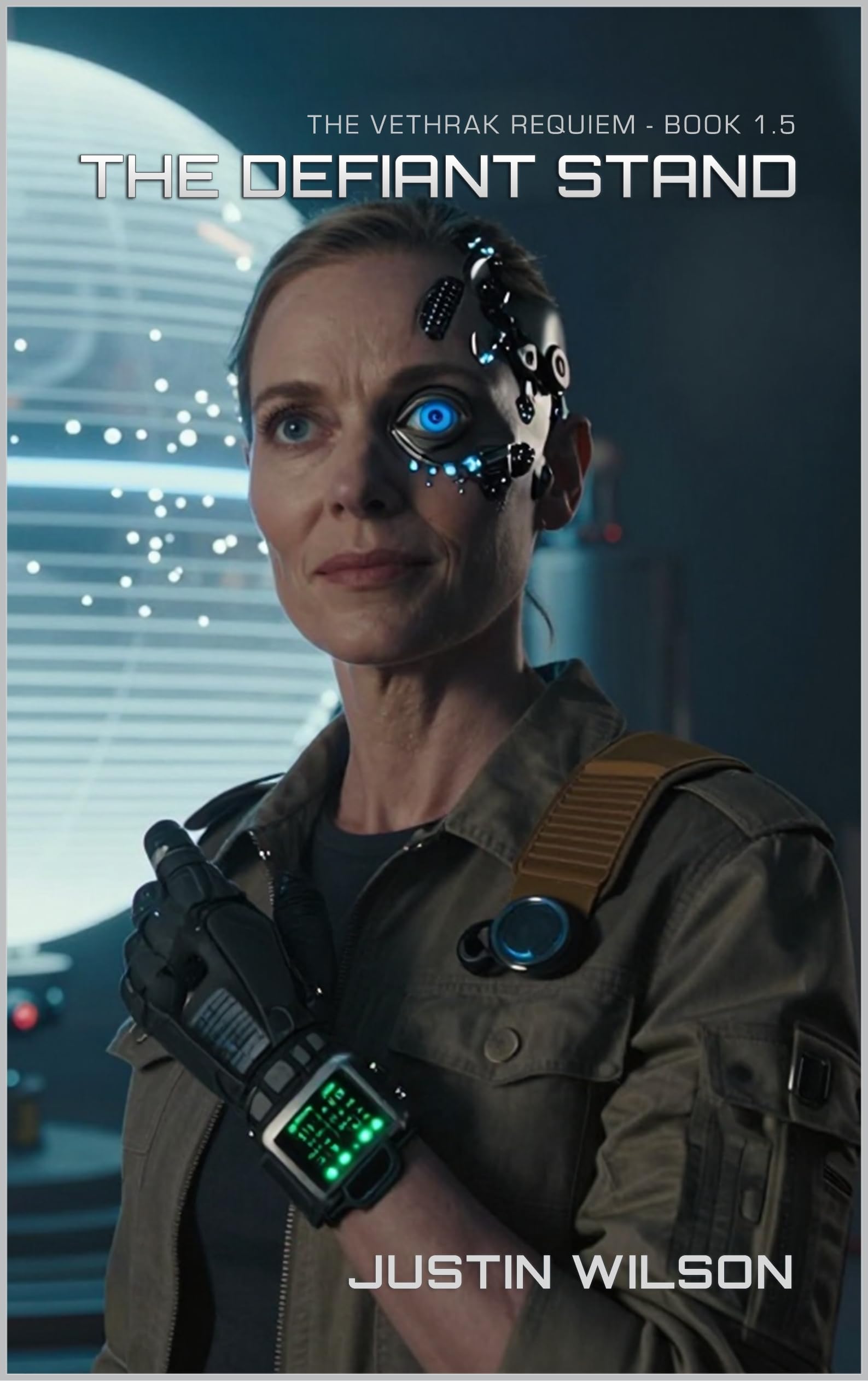

What's the story behind the story? What inspired you to write this book?
The Tau Ceti Gambit was always going to be about the ships that left. Hope and Vanguard crossing twelve light-years, finding allies, finding new enemies. That book had its own gravity. The question that kept nagging at me was simpler: what about the ship that stayed? Someone had to guard the construction berths while Hope and Vanguard finished their retrofits. Someone had to watch the fuel lines, run the patrols, keep the Sol System alive long enough for the fleet to launch. That story belonged to the UENS Defiant. It also belonged to Marcus and David Rivera, brothers who had been on the same bridge for twelve years and had never once talked about the invasion that shaped them both.
The relationship was there from the beginning, sitting quietly under everything. Marcus carries the trauma. David covers for him without naming it. Twelve years of silence between two men who love each other and cannot find the words. I wanted to give them the room to break that silence. To find out what happens when the rear guard can no longer afford to keep its scars buried.
The Defiant Stand is the book about the people who do not get the parade. They get the homecoming. I think that’s enough. I think it might be the harder, holier job. That was the inspiration: a ship in the dark while everyone else reached for the stars, and two brothers learning that holding the line costs more than they thought it would.
If you had to pick theme songs for the main characters of your book, what would they be?
Yes. This is the question I have been waiting for. If we’re playing in Steve Jablonsky’s sandbox, here’s the playlist:
Captain Marcus Rivera: “Arrival to Earth” (Transformers, 2007)
The track is a man remembering everything he lost while finding the strength to stand up anyway. Listen for the slow, elegiac opening into the brass swell. That’s Marcus on the bridge at the worst moment of Chapter 12, watching alien energy spike and refusing to flinch a second time.
Commander David Rivera: “Honor to the End” (Transformers: Age of Extinction)
David’s arc is becoming the leader his brother needs without resenting it. The rear guard’s anthem. Duty without complaint. It’s the music for a man who chose the harder job and never asked for credit.
The UENS Defiant herself: “No Sacrifice, No Victory” (Transformers: Revenge of the Fallen)
The ship is a character. She patrols the dark while the glory ships leap for the stars. The title alone is the entire book in five words.
Bonus pick, Weronika Mazur (the woman holding the dead man’s switch on Helios-Beta): “The Fallen” (Transformers: Revenge of the Fallen)
A villain who believes she’s saving humanity by ending the expansion needs the kind of music that takes her conviction seriously. Jablonsky writes antagonists who think they’re right. Mazur deserves nothing less.
If you only listen to one track before reading the book, make it “Arrival to Earth.” That’s the whole novella in four minutes.
What's your favorite genre to read? Is it the same as your favorite genre to write?
Sci-fi, all the way down. Specifically, the kind that takes ideas seriously and people more seriously than the ideas. A few that shaped me:
Leviathan Wakes: the gold standard for modern space opera. Holden, Naomi, Amos, and Alex on the Rocinante are exactly the kind of working-class crew dynamic I want my readers to feel when they board the Defiant. Corey writes physics that hurts and politics that breaks. Every military sci-fi writer working today is in their debt, and most of us know it.
Hyperion: a pilgrim caravan moving toward something terrible while each one tells their story. The Priest’s Tale alone is worth the entire shelf. Faith, grief, time, sacrifice. All of it on the page without a single cheap answer.
Old Man's War: proof that military sci-fi can be funny without being unserious. Scalzi’s voice is loose and lethal at the same time. I learned a lot from him about pacing and how to keep the reader leaning forward.
Ender's Game and Speaker for the Dead: the books that taught me children’s war stories are also adult moral reckonings. Speaker for the Dead is the better book. Most series go the other way.
Same as what I write? Mostly yes. The Vethrak Requiem is the book I wanted to read. First contact handled like an adult, ships that feel like working vessels, characters who carry their wounds without performing them, faith in the room without preaching from it. I write what I miss when I look at my shelf.
What books are on your TBR pile right now?
Here’s what’s stacked on my desk right now:
The Three-Body Problem trilogy by Liu Cixin. I read the first one years ago and have been circling Death’s End ever since. The scope of that ending sequence is one of the most ambitious things in modern sci-fi. I keep waiting for a stretch of brain space large enough to do it justice.
Children of Time / Children of Ruin / Children of Memory by Adrian Tchaikovsky. Tchaikovsky is doing the thing I most respect in sci-fi: taking alien intelligence seriously as alien. Spider civilizations, octopus civilizations, AI consciousness. All of it was written without humanizing the aliens into safety. I want to see how he sustains it across the trilogy.
A Memory Called Empire and A Desolation Called Peace by Arkady Martine. Readers, I trust, keep telling me Martine is writing the empire-and-language epic for our generation. The premise alone is worth the read: an ambassador trying to integrate her dead predecessor’s memory into her own consciousness. That’s a real question dressed in space opera.
Pandora's Star by Peter F. Hamilton. Working up the courage. Hamilton writes door-stoppers that earn their length, and Pandora’s Star is on every “best space opera” list ever assembled. I’ve been told to clear a month before starting.
A Canticle for Leibowitz by Walter M. Miller Jr.. The post-apocalyptic monastery novel I should have read a decade ago. Monks preserving fragments of pre-collapse science across centuries while civilization rebuilds and falls and rebuilds again. Friends keep telling me it will rewire how I think about The Vethrak Requiem.
The honest truth is the pile is always larger than the year. The only way through it is to keep choosing.
What scene in your book was your favorite to write?
The end of the book. No question. Without spoiling anything, here is what I can tell you. The climax runs on two fronts at the same time. Marcus is on the bridge of the Defiant, surrounded by his crew, fighting an enemy that includes the thing inside his own head. David is inside Helios-Beta with a rifle on a woman whose heartbeat is a weapon. Two confrontations stacked on top of each other, each one happening in real time, each one impossible without the other working too.
I have wanted to write that scene since I knew there was going to be a Defiant Stand. The hard part was making the trauma into a resource instead of an obstacle. For twelve chapters, Marcus has been managing his ghosts with discipline and breathing exercises. The final confrontation refuses him those tools. The signal is too strong. The frequency is too close to the original. What is left when the management techniques fail is older. That was the line I wanted to land on.
The other piece I loved writing was the chain of trust. Three people who barely know each other passing one specific kind of knowledge across hundreds of millions of kilometers, the success of the whole thing depending on whether the third person in the chain still has enough of what was passed along to make it work. Three degrees of separation between her and the alien mind that built the device she is trying to disarm. I wrote that chapter holding my breath.
The hardest part to get right was the antagonist’s argument. The villain who is wrong and knows she is wrong is easy. The villain who is wrong and has reasons that hurt to listen to is the one who earns the chapter. I rewrote her dialogue more times than any other piece of the book.
If the final confrontation lands, it lands because everything before it was preparing the reader for what the brothers each have to do alone. That was the bet I made. The reader gets to decide if it cleared the bar.
Do you have any quirky writing habits? (lucky mugs, cats on laps, etc.)
Honestly, no. Not the fun answer. No lucky mug. No cat on the lap. No specific playlist that has to play in a specific order. No ritual, no writing hours dictated by the lunar cycle. The quirkiest thing about my process might be how unquirky it is.
What I actually need is simple. A good cup of coffee, two or three across the session. Quiet space, the kind where nothing else competes for attention. Time to sit with the canon files before I write anything new.
That last one might be the closest thing I have to a habit. Before I draft a chapter, I will pull up the wiki of locations, characters, technology, faction politics, and walk through whatever sections that chapter is going to touch. Not to look anything up. To feel the world. The Vethrak Requiem has too many moving parts to fake from memory, and the act of rereading the canon files puts me back in the universe in a way nothing else does.
The coffee fuels the writing. The quiet protects it. The canon files anchor it. That is the whole ritual. Less Instagram-worthy than a candle and a fountain pen. More effective for the work.
Do you have a motto, quote or philosophy you live by?
“Whoever is faithful in very little is also faithful in much.” That is Luke 16:10, and I have been carrying it for years. It is the verse that makes the most sense to me as both a Christian and a builder. The small thing is the real thing. The line of code that gets written when nobody is watching. The commitment to a wife or a child that nobody else will ever see. The chapter that gets drafted on a Tuesday night when the project would not suffer if it slipped a day. None of those moments feel important in isolation. All of them are the foundation of whether the bigger moments hold.
I have spent two decades building enterprise platforms, and the systems that scale are the ones whose authors were faithful in the small things. The same is true of marriages. The same is true of books. The same is true of faith itself.
It is also the philosophy underneath The Vethrak Requiem. The Defiant is the small thing. Marcus and David are not the heroes who left for the stars. They are the rear guard. Their job is to be faithful where they are placed, in the unglamorous work, while everyone else gets the parade. That is the job. That is the whole point.
Faithful in the small things. The big ones tend to take care of themselves when the small ones are tended.
If you could choose one thing for readers to remember after reading your book, what would it be?
That holding the line is its own kind of valor. Most of us are not going to get the parade. We are not going to be the ship that crosses twelve light-years or the name carved on a monument or the face on a recruitment poster. Most of us are going to do the rear guard work. The unglamorous shift. The job that nobody is going to write a book about, except this one. That work matters. The fuel lines matter. The patrols matter. The brother on the bridge next to you, the daughter at home, the colleague at the desk beside yours, the small daily fidelity to a post nobody is watching. All of it is what holds civilization upright while the bigger stories happen somewhere else.
Marcus Rivera does not save the galaxy. He saves a fuel station. David Rivera does not lead a fleet. He leads four marines through one corridor. The thing they accomplish is small in the scope of the war and unconditional in the scope of their lives. That is the whole book. The line holds because someone is on the other side of it. Sometimes someone is your wife. Sometimes it is your brother. Sometimes it is the four hundred and eighty crewmates, depending on you to be what they need for one more shift.
If you finish The Defiant Stand and walk away with one thing, walk away with that. Whatever post you have been given, the work is enough. The faithfulness is enough. The line you hold matters more than you think it does. The fleet leaves. The Defiant stays. Both held the line.
Justin Wilson is the author of the new book The Defiant Stand (The Vethrak Requiem)
Connect with Justin Wilson