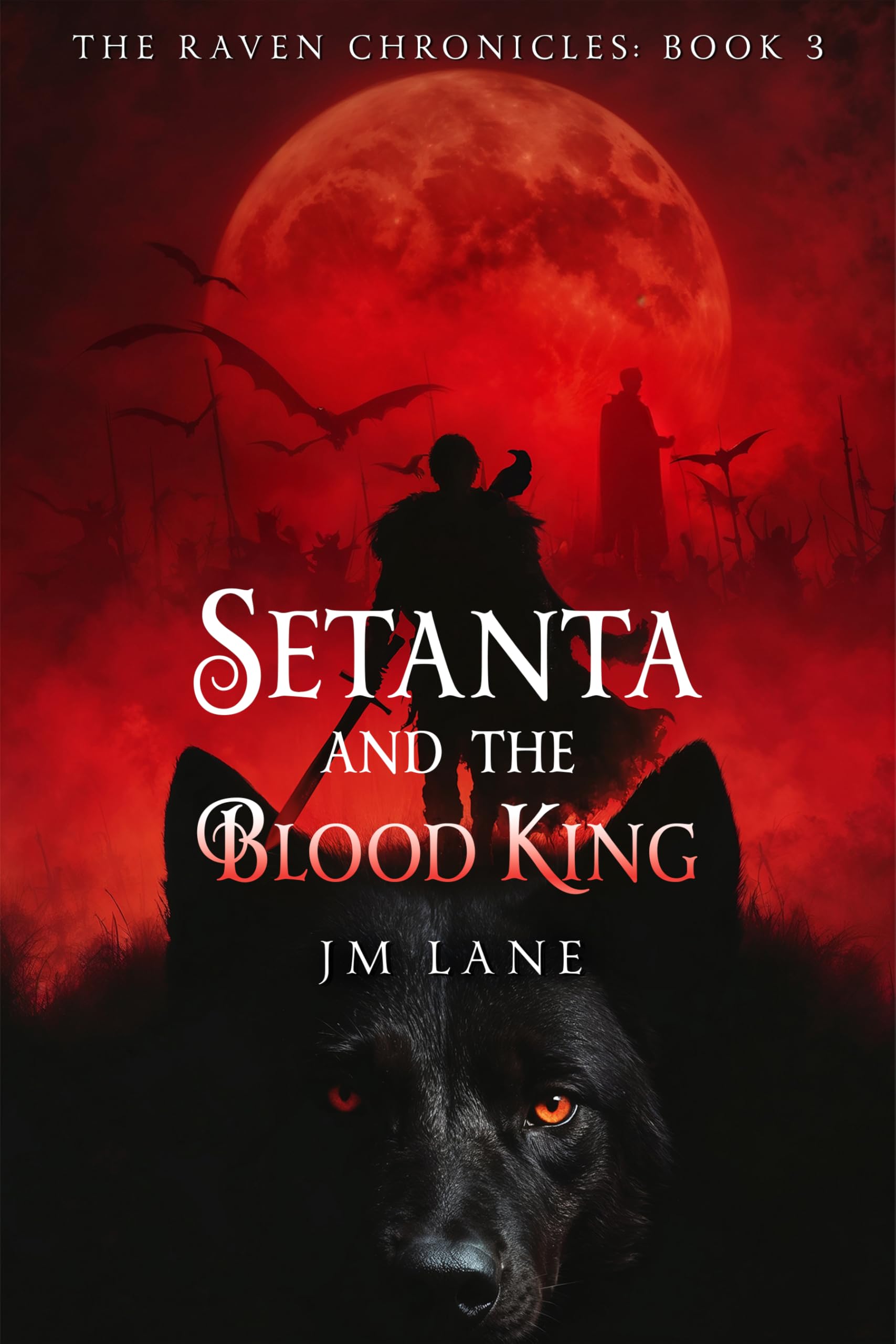

What's the story behind the story? What inspired you to write this book?
I wrote Setanta and the Blood King while I was in remission from cancer. That period is a strange place to be in. You are past the worst of it, but now nothing feels the same. You are left with what lingers after surviving—the physical side of it, but also the questions that stay with you long after the treatment ends. I found myself thinking a lot about the relationship between parent and child. About what we pass on without meaning to. Not just the good things, but the weight of life, the fear of it, the silences it calls hold. There is a kind of inherited trauma that does not announce itself. It just settles in and shapes you over time. Becoming a father and then facing illness made that feel very real to me. Irish myth and folklore gave me a way to process that. Those stories do not soften things. They deal in consequence, in memory, in blood.
They understand that the past is not gone. It lives on in people. It follows them. That felt honest to me, and it gave me a language to explore those ideas without turning away from them. At the same time, I wanted this book to move. This is the fastest and most action-packed story in the series. It throws Setanta into situations where he has to act, where there is no time to think his way out of things. That felt true to the emotional side of it as well. Sometimes life does not give you the space to process. You just have to stand and deal with what is in front of you. Even though it is part of the Raven Chronicles, it can stand on its own.
A reader can come into this book without having read the others and still get a complete story. It works as a point of entry, but for those who have followed Setanta, it marks a real turning point in who he is becoming. At its core, it is not just about fighting monsters. It is about facing what has been handed down to you and deciding what you are going to do with it.
If you had to pick theme songs for the main characters of your book, what would they be?
I would choose The Foggy Dew for Setanta because it carries the same weight that my story is trying to explore. It is not just a song—it is about inheritance, sacrifice, and the moment a person is called to stand for something bigger than themselves. The original meaning of the song comes from the aftermath of the 1916 Rising. It reflects on Irish men who chose to fight and die at home, rather than in foreign wars. There is a strong sense in it that their actions were tied to land, identity, and memory. It is about choosing to stand your ground, even when the cost is high. That connects directly to Setanta. He is not simply facing monsters. He is stepping into something older than himself.
He is dealing with what has been passed down to him, whether he wants it or not. Like the figures in the song, he reaches a point where he cannot stay a bystander. He has to act. There is also something in the tone of the song that feels very Irish to me. It is not loud or triumphant. It carries a kind of quiet gravity. That restraint, that sense of history sitting just beneath the surface, is exactly the atmosphere I try to bring into the Raven Chronicles. So for me, it is not just about matching a song to a character. It is about choosing something that reflects the deeper themes of the story—the idea that the past is never gone, that we inherit more than we realize, and that at some point, we are all asked to stand and face it.
What's your favorite genre to read? Is it the same as your favorite genre to write?
I tend to read more horror and literary fiction than fantasy. I am drawn to work that explores the human condition in an honest way, even when it is uncomfortable. Writers like Colum McCann, Cormac McCarthy, and Annie Proulx really resonate with me for that reason. There is a depth and a quiet weight in their work that stays with you. At the same time, I am very interested in stories about outsiders and people on the edges of things. Authors like Joe R. Lansdale and Dennis Lehane bring a different kind of energy to that.
There is grit there, and a willingness to look at characters who do not fit neatly into the world around them. Horror has always been a big influence as well—Richard Matheson in particular, and later Stephen King. What I admire about them is how they use horror not just to frighten, but to get at something deeper about fear, isolation, and what it means to be human. So while I write within a mythic or folkloric space, the books I am drawn to are really about people, about pressure, and about what is revealed when characters are pushed to their limits.
What books are on your TBR pile right now?
At the moment, my TBR reflects that same pull between literary work and something with a bit of edge to it. I have 84, Charing Cross Road on the list, which I have always been drawn to for its simplicity and its focus on connection and voice. It is very different from what I write, but that is part of the appeal. I also have Ashes and Stones on there, which leans more into the darker side of storytelling. That mix probably says a lot about me as a reader. I am interested in both ends of it—the quiet, human moments, and the stories that push into something more unsettling. That balance is something I try to bring into my own work as well.
What scene in your book was your favorite to write?
The scene that stands out for me is the one with Dominic. What I like about it is how controlled it is. Everything tightens in that moment. It is not loud or dramatic in the way you might expect. It is very focused, very deliberate. There is a real sense of tension underneath it. You can feel that something important is about to happen, even if you cannot quite see how it will unfold. For me, it captures a shift in Setanta—not through spectacle, but through restraint. Through the weight of a moment that changes things, even if it is not spelled out. It is one of those scenes that stays with you afterwards, not because of what is shown, but because of what it means.
Do you have any quirky writing habits? (lucky mugs, cats on laps, etc.)
I tend to write very late at night. There is something about that time when everything is quiet, and there are fewer distractions. It feels easier to get closer to the work, especially with the kind of stories I write.
As for a lucky charm, I would not call it that exactly, but I do have a habit of taking a few pulls on a tobacco pipe before I settle into writing. It is a small ritual more than anything—a way of marking the shift from everything else into the work. It helps me slow down and focus, which is no harm at all when you are dealing with dark material.
Do you have a motto, quote or philosophy you live by?
Kindness costs nothing, and it is something I try to give freely whenever I can.
If you could choose one thing for readers to remember after reading your book, what would it be?
One thing I would hope a reader takes from the book is this: you are not the owner of your parents’ sins. We inherit many things, but we still have a choice in who we become.
JM Lane is the author of the new book Setanta and The Blood King (The Raven Chronicles Book 3)
Connect with JM Lane