

What's the story behind the story? What inspired you to write Death at Falconfields?
At one point, a couple of years ago, I was having trouble finding a mystery series that was exactly what I wanted to read. When I do find one, I read all the books in order—I rip through them, and then I want another series. They never last long enough! So I decided to write a series. That way, I was immersed in one mystery series (mine!) for about two years. Writing a series is as much fun as reading one. I’ve written books 2 and 3 of Murder on the Gulf Coast, and I’m working on book 4.
What's your favorite genre to read? Is it the same as your favorite genre to write?
Absolutely—murder mysteries with a good detective! I can enjoy a good thriller, but it’s not what I like best. I don’t really want a book to scare me or make me anxious. I want a book to intrigue me, to engage my brain. I like puzzles and logic. I grew up reading Golden Age detective fiction: Agatha Christie, Dorothy Sayers, P.D. James. Actually, I grew up reading Nancy Drew! Starting in about third grade, I read all the Nancy Drew books more than once.
What books are on your TBR pile right now?
I read a sample of Lisa Jewell’s None of This is True last night and had to order the book. I see that Lucy Foley (The Paris Apartment) has written a Miss Marple! Can’t wait, but it’s a pre-order, almost a year off. So I now have The Midnight Feast (also Lucy Foley) up next.
I have pre-ordered and eagerly await Sujata Massey’s 5th Perveen Mistry book, The Star of Calcutta. I loved Massey’s historical fiction boxed set, India Gray.
Also on my TBR: Murder on the River by Janice Frost, Warwick and Bell #5. Love the series. While I enjoyed Gretta Mulrooney’s other books (Tyrone Swift, Siv Drummond), I loved her two Daisy Moore mysteries (Death at the Dolphin is the first), and I’m fervently hoping she’ll write another one.
What scene in your book was your favorite to write?
My detective, Gil Tillier, visits the two women who found the body. Lucie is into genealogy, and she is our channel into the distant past—things people did way back that still have repercussions decades and even generations later. I am not into genealogy myself, but like Lucie, I have a lot of old letters, photographs, and personal memoirs from my family. For me, these individual accounts bring the past to life more than any academic history book.
In a murder mystery, I like a crime with long roots, and I love the challenge of bringing long-lost acts to light. In three of my four standalone mysteries (Blue Lake, Lay Death at Her Door, and Accidents of Life), the chief crime occurred long in the past and still casts a shadow twenty or thirty years later.
Do you have any quirky writing habits? (lucky mugs, cats on laps, etc.)
My weird thing is that I get up very, very early every day—4 AM!—to write. No alarm—I just wake up. This is totally voluntary. It’s still dark at that hour and very quiet. My inner critic is still asleep. I recently read that Martha Stewart gets up at 4, too. She does brain games and Pilates at that hour. Dolly Parton gets up at 3 AM! She says she does her most creative work in those earliest hours of the day.
Do you have a motto, quote, or philosophy you live by?
Confucius says, “He who has no patience cannot win.” Confucius also says, “It does not matter how slowly you go so long as you do not stop,” and “One who moves a mountain begins by carrying away small stones.” Another Chinese philosopher, Laozi, a contemporary of Confucius, said that the journey of a thousand miles begins with one step. It’s all the same idea, really, and writing a novel requires exactly this mindset. It is the work of a tortoise, not a hare.
If you could choose one thing for readers to remember after reading your book, what would it be?
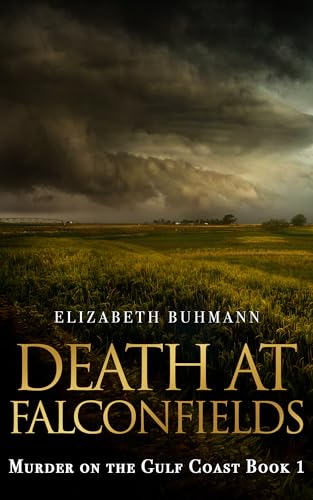
What’s most evocative for me is the place. Falconfields is an old plantation near a small town in southern Alabama. It’s fictional, of course, but its features are drawn from reality. According to local legend, the original plantation house was burned down in vengeance by the ghost of a young Black woman. Its rich land was once worked by a hundred enslaved people, then sharecropped by their descendants.
Plantations are not the subject of my book, but they’re part of the setting: the Gulf Coast, from Louisiana to the Florida Panhandle. Most plantations were defunct soon after emancipation, belonging to the past by more than a hundred and fifty years. But they are still a dimension of the landscape—and their histories are dark.
Writing this book, I was drawn into the thought-provoking subject of plantation tourism. Some 300 plantations across the southern United States generate billions in revenue each year. Many of these sites romanticize the privileged lives of the antebellum planter class. Some make no mention of slavery, in spite of the fact that the grand houses were built by enslaved people to display wealth generated by slave labor.
Of course, Falconfields is a murder mystery, a detective story. But I came away feeling the echo of that profound aspect of our country’s past.
Elizabeth Buhmann is the author of the new book Death at Falconfields
Connect with Elizabeth Buhmann
Sign up for our email and we’ll send you the best new books in your favorite genres weekly.