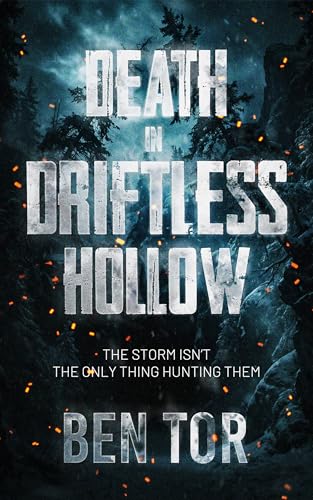

What's the story behind the story? What inspired you to write this book?
I wrote Death in Driftless Hollow because I don’t think most of us are afraid of “big” things. We’re afraid of what happens inside us when the rules change. We live by old wiring—fight, flee, freeze—while modern life teaches us to smile, push through, and call it “fine.” Many of us are not fine. We avoid. We manage. We negotiate with our own nervous systems. And sometimes that works—until it doesn’t. The Driftless gave me the perfect stage—and I genuinely love the land here. It’s beautiful. Remote when you want it. Quiet in a way that feels like permission. A pocket world—the kind of place you go to reset. But this story isn’t about relaxation. It’s about the body’s drive to stay alive. At its core, the book is about transformation through ordeal—the brutal kind that doesn’t ask politely. The ancient calamities by which humans once lived and died are reapplied to modern characters I’ve grown to adore—even, and especially, the ones who don’t survive. When comfort dissolves, and safety proves fragile—who decides what survival looks like? That’s the question behind DDH.
What's your favorite genre to read? Is it the same as your favorite genre to write?
I read just about anything—fiction and nonfiction—but I’m consistently drawn to stories that test people under pressure in interesting environments. Thrillers, especially those built around isolation or survival, are probably closest to my center. I’m fascinated by what happens when the rules change—when weather, geography, or circumstance strip away comfort and force characters to confront something older inside themselves. That interest cuts across genres more than it might seem. I can enjoy the tight, escalating tension of something like Freida McFadden’s One by One, the oceanic dread of Mira Grant’s Into the Drowning Deep, or the more intimate wilderness ordeal of Stephen King’s The Girl Who Loved Tom Gordon (loved). There are also quieter, harsher works that I approach with respect—Cormac McCarthy’s The Road, or Adam Nevill’s The Ritual—stories that linger because they’re unflinching about what survival costs. So yes—the genre I most love to read is also the one I most love to write. Stories where isolation isn’t just a setting, but a human catalyst.
What books are on your TBR pile right now?
I prefer paper books. So at the moment, my TBR is a literal book pile. A mix of survival and psychological thrillers—Michael Rutger’s The Anomaly, C.J. Cooke’s The Ghost Woods, and a couple of winter-set suspense novels that I’ve somehow missed. And then, inevitably, there are a few completely unrelated books waiting their turn. The pile grows faster than I can read it!
What scene in your book was your favorite to write?
My favorite scene to write wasn’t the most violent—it was the moment fear becomes useful. There are points in the story where panic stops being a “flaw” and starts being a survival tool. Writing that shift—from avoidance to acceptance—felt like the heart of the book. That’s where transformation through ordeal really begins.
Do you have any quirky writing habits? (lucky mugs, cats on laps, etc.)
Death in Driftless Hollow was nearly 20,000 words longer at one point. I tend to overwrite first and then carve the story back down until only what’s necessary remains. At some point in every project, I print the manuscript and read it on paper. Something shifts when the words leave the screen. I see rhythm differently. It’s a slower, more honest read for me. So no lucky mug—just a stack of marked-up paper pages!
Do you have a motto, quote or philosophy you live by?
“Endure, and see.” Those who’ve read Death in Driftless Hollow will recognize the spirit of it. We humans live imperfectly and only once—and that’s okay. We’re fragile creatures, finite and flawed, clinging to a rock racing through space, and yet we spend enormous energy trying to avoid discomfort in our narrow context. But avoidance rarely saves us. Life will bring pain, trauma, and trials we never asked for. We suffer less, I think, when we endure them with acceptance rather than resistance. Ordeal changes us. And if we’re a little more willing to stay through it, something honest and better can be revealed on the other side.
If you could choose one thing for readers to remember after reading your book, what would it be?
If Mara’s fear felt recognizable, I hope readers remember that panic or anxiety is not a personal failure. We carry ancient wiring. Sometimes it misfires. Sometimes it’s simply loud. But the suffering we often endure alone in silence—the loops, the scary thoughts, the dread, the unease—are shared human experiences. We are not alone in them. And we are not broken because of them.
What is your Author Website?
https://www.bentorauthor.com/