Interview with Alexander Titus, Author of Synthetic Eden
14 Nov 2025
What’s the story behind the story? What inspired you to write Synthetic Eden?
I’ve spent my career at the intersection of biotechnology, national security, and ethics—working with the same tools that could one day save or destroy our species. Synthetic Eden grew from a simple, haunting question: what if we finally solved climate collapse or extinction—but only by rewriting the code of life itself? The novel began as a thought experiment about responsibility in science and became a meditation on survival, guilt, and creation. I wanted to explore how humanity might react when the line between “saving the world” and “playing god” disappears. The story follows Dr. Samara Makinde, a geneticist who becomes both scapegoat and savior after a catastrophic biotech accident. Her journey off a dying Earth isn’t just physical—it’s moral. She carries with her the knowledge that our greatest brilliance often comes paired with our deepest hubris. Writing Synthetic Eden was my way of turning the questions I wrestle with as a scientist into an emotional journey readers could feel. It’s not a warning—it’s a mirror.
If you had to pick theme songs for the main characters of Synthetic Eden, what would they be?
For Samara Makinde, I’d choose “Runaway” by Aurora—it captures the ache of leaving everything behind to search for a version of hope that still feels human. For Lucas Mercer, the ship’s precise yet deeply wounded pilot, it would be “Atlas: Space” by Sleeping at Last, because beneath his control lies the quiet grief of someone who sees beauty as something fleeting. And for Aurelius Hofstadter—the visionary billionaire who builds humanity’s escape—the only fitting song is “Viva la Vida” by Coldplay, that ironic anthem of fallen kings. Each character’s song mirrors their moral gravity. Together they form a symphony of longing, control, and consequence—the emotional score of a civilization trying to out-engineer extinction.
What’s your favorite genre to read? Is it the same as your favorite genre to write?
My reading tastes orbit the same gravitational field as my writing: science fiction that takes ideas seriously but never forgets the human heart. I read widely—literary fiction, philosophy, systems theory, and the occasional field manual—but I’m most at home in speculative worlds that feel one experiment away from reality. Writers like Emily St. John Mandel, Cixin Liu, Ursula Le Guin, and Richard Powers remind me that science fiction isn’t about the future—it’s about the present stretched to its breaking point. I write in the same space, but my aim isn’t prophecy. It’s empathy. Whether through Synthetic Eden or the broader Echoes of Tomorrow series, I use fiction as a lab for moral imagination: a way to test what happens when technology, responsibility, and human fragility collide.
What books are on your TBR pile right now?
My current stack looks like a conversation between a biologist and a philosopher after too much coffee. I’m reading “The Ministry for the Future” by Kim Stanley Robinson, “Tomorrow, and Tomorrow, and Tomorrow” by Gabrielle Zevin, and revisiting “The Gene” by Siddhartha Mukherjee. I also have a perpetual re-read of Mary Shelley’s Frankenstein on standby—it’s the original biotech ethics novel. Every time I read it, I find new echoes between her 19th-century fears and our 21st-century ambitions. Beyond fiction, I’m diving into The Alignment Problem by Brian Christian and a stack of papers on AI-for-science systems. I read the same way I build ideas: across disciplines. The most interesting ideas usually live in the space between them.
What scene in your book was your favorite to write?
The moment Samara looks down at Earth from orbit—seeing it dead and brown for the first time—was the scene that haunted me before it was even written. It’s quiet, almost reverent. She’s not watching an explosion or a battle; she’s witnessing the end of home. That moment embodies the emotional core of Synthetic Eden: what if survival feels like betrayal? I wanted the reader to feel both awe and nausea, to recognize that leaving a dying world doesn’t mean escaping responsibility for it. That scene feels like standing in two centuries at once—one ending in ruin, the other beginning in the vacuum of possibility. Every novel has a moment when you realize what it’s truly about. That was mine.
Do you have any quirky writing habits? (lucky mugs, cats on laps, etc.)
I write like an observer running thought experiments on reality. Every day, I notice something—a news headline, a scientific paper, a fleeting human gesture—and ask, what if? What if that trend continued? What if that discovery was taken too far? What if that quiet moment revealed something about who we’re becoming? Those questions form the raw data of my imagination. My notebooks are filled with field notes, small observations that I later extrapolate until the line between fact and fiction blurs. Writing longhand slows my mind enough to notice patterns before invention takes over. It’s less about building worlds than extending this one by a few degrees, tracing the logic of what could happen next. Once the story catches, it feels less like creating and more like modeling an alternate reality—one where imagination is the experiment, and empathy is the result.
Do you have a motto, quote, or philosophy you live by?
My life—and my writing—centers on one line: “At the frontier of technology, humanity is the experiment.” It’s both caution and invitation. Whether I’m working in biotech, advising on AI, or writing novels about the future, I believe the real question isn’t what we can build—it’s who we become when we build it. Every advance in science is also a mirror for the soul. My work, from research to fiction, is about exploring that reflection honestly—celebrating progress without losing our humanity in the process.
If you could choose one thing for readers to remember after reading your book, what would it be?
I hope readers remember that every apocalypse is, at its core, a human story. Synthetic Eden isn’t about technology run amok—it’s about what happens when our ambition outpaces our empathy. Samara Makinde survives the end of the world not because she’s brilliant, but because she refuses to stop caring, even when it hurts. If readers close the book feeling unsettled but strangely hopeful—questioning how far they’d go to save what they love—then the story did its job. The world doesn’t end in one cataclysmic moment; it ends a million quiet times in the choices we make. But the inverse is also true: we rebuild it in the same way. One act of courage, compassion, or curiosity at a time.
Alexander Titus is the author of the new book Synthetic Eden
Connect with Alexander Titus
Author Site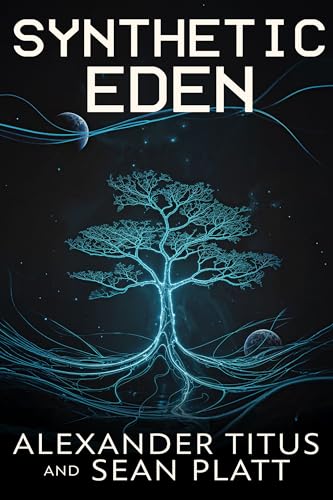
Sign up for our email and we’ll send you the best new books in your favorite genres weekly.

zaida
Recommended Posts
Interview with Zemo Trevathan, Author of The Adventures of Casey, Kendall and The Stucco Beings
04 Feb 2026 - Author Interviews, eBook, News, Young Adult