

What's the story behind the story? What inspired you to write The Dandelion Tree: Part Two (The Dandelion Chronicles Book 3)?
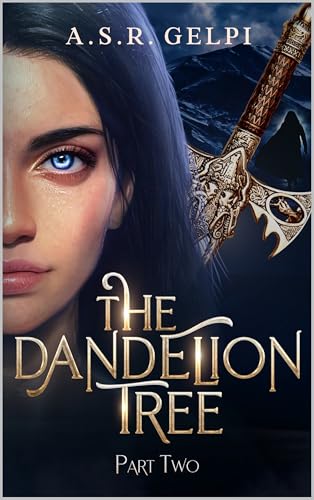
Kharis, the main character, is on a journey against time to find the spell that can undo her curse. If she fails, she’ll go mad and die—and the one tasked with her execution is her beloved sister. Finding a way to break the curse also means freeing Saya from her terrible duty. To do this, Kharis must brave the world of ancient immortals, outwit the scheming Aghet Mendi, and face the truth her fiercest guardian, Itzu, has long kept hidden. When she finally stands before the Akumi king—the demon and source of her torment—will he offer salvation or annihilation? As fate tightens its grip, Kharis must decide whether to preserve her soul or sacrifice everything to end the cycle of ruin.
Darkly lyrical and emotionally fierce, The Dandelion Tree, Part Two is a literary epic fantasy that weaves myth, memory, and magic into a tale of aching humanity. This third volume in The Dandelion Chronicles favors character over combat, consequence over spectacle, and prose that lingers. For readers of Jacqueline Carey and R.F. Kuang, this story unfolds like poetry—layered, deliberate, and intimate in scale yet mythic in scope. Readers who enjoyed The Books of Ambha, The Goblin Emperor, The Poppy War, The Bear and the Nightingale, She Who Became the Sun, and Tigana will find resonance here.
I love Kharis fiercely. She began as the mirror of an angsty teenager and soon became her own person. The inspiration for her story was years in the making. It began when I was thirteen, pondering what to write in my English class journal (my teacher required us to write every day, but life in a sleepy town doesn’t give much material). Soon, I started writing short stories, including snippets about this character, and my teacher loved it. Instead of having me write about daily life, he let me write stories and often added comments and questions that guided how they evolved.
But Kharis’s story didn’t become solid until much later. My Ph.D. work had me poring over ancient sagas, and the richness of that storytelling became the foundation for this world. It took years to write because life adds to one’s pot—from family to academia. It wasn’t until the COVID-19 pandemic that I finally decided to put nearly thirty years of notes and journal entries into a story—and it became a series of ten books.
If you had to pick theme songs for the main characters of The Dandelion Tree: Part Two (The Dandelion Chronicles Book 3), what would they be?
I’m a sucker for the music in video games. There. I’ve said it. And I listen to it when I am writing or revising. Some of my favorite composers are Dwayne Ford, Jo Blankenberg, Audiomachine, Eternal Eclipse, Yuri Ierusalimov, Brian Delgado, Atom Music Audio, and many more. If it’s epic and cinematic, I will listen to it. I’ve also fallen in love with Epic: The Musical scores by Jorge Rivera-Herrans. Dvizia is also up there. Overall, I look for music that matches the mood of the scene I’m working on, and thus, from epic battles to passionate vows, my YouTube playlist has it.
What's your favorite genre to read? Is it the same as your favorite genre to write?
I read mostly fantasy, and this is also the genre in which I write. First, why fantasy? I love how this is such a fluid genre, allowing me to create worlds (which is my favorite aspect of writing fantasy). Speculative fiction is where “words truly conjure worlds.” Now, why do I read fantasy? The answer is simple. Fantasy is such a diverse subgenre of speculative fiction. There’s epic, high, low, romantasy, dark, grimdark, Asian, urban, historical, fairy tale, steampunk, gaslamp, Arthurian, portal, wuxia, magical realism—and the list goes on and on.
What books are on your TBR pile right now?
I am a mood reader, and that means that I am reading several books at a time. Currently, I am rereading Assassin’s Apprentice by Robin Hobb and pondering whether to restart the Earthsea series by Ursula K. Le Guin. We are told that Tolkien was the father of fantasy, but that is WRONG, WRONG, WRONG. Jules Verne had already published fantasy books prior to Tolkien, and the list of pre-Tolkien fantasy authors is vast. But I digress… Also reading as the mood strikes: Age of Swords by Michael J. Sullivan; The Fall (novella) by Ruan Cahill; The First Witch of Boston by Andrea Catalano; Novice by Taran Matharu; A Court of Silver Flames by Sarah J. Maas; House of Sky and Breath, also by Sarah J. Maas; and Project Hail Mary by Andy Weir. On the nonfiction side of things, I am reading the following to continually improve my writing craft: Vex, Hex, Smash, Smooch by Constance Hale; Bird by Bird by Anne Lamott; Story Genius by Lisa Cron; and Save the Cat! by Blake Snyder.
What scene in your book was your favorite to write?
For this book… I have so many! But any scene with Kharis and Itzu was a joy. I also enjoyed writing all the high-action scenes, which means I especially loved writing the ones between Kharis and Aghet Mendi (the antagonist).
Do you have any quirky writing habits? (lucky mugs, cats on laps, etc.)
I do drink a lot of tea or coffee, depending on the scene. Action-packed scenes come with coffee; contemplative ones come with tea. I also listen to music (no words) to get into the mood. My desk faces a blank wall where I have posted the stakes and consequences for the book in question. Every chapter must echo them to create a sense of anxiety and dread for the character. It also helps me ensure that every chapter propels the story.
Do you have a motto, quote, or philosophy you live by?
My favorite motto is “Words conjure words.” This is a powerful quote that goes beyond writing. The words you use to describe yourself or others also conjure the emotions and feelings we have for ourselves or others. Thus, words must be used carefully and thoughtfully. Words create thoughts that lead to action. Words break, but words can also heal and mend.
If you could choose one thing for readers to remember after reading your book, what would it be?
A.S.R. Gelpi is the author of the new book The Dandelion Tree: Part Two (The Dandelion Chronicles Book 3)
Connect with A.S.R. Gelpi
Sign up for our email and we’ll send you the best new books in your favorite genres weekly.