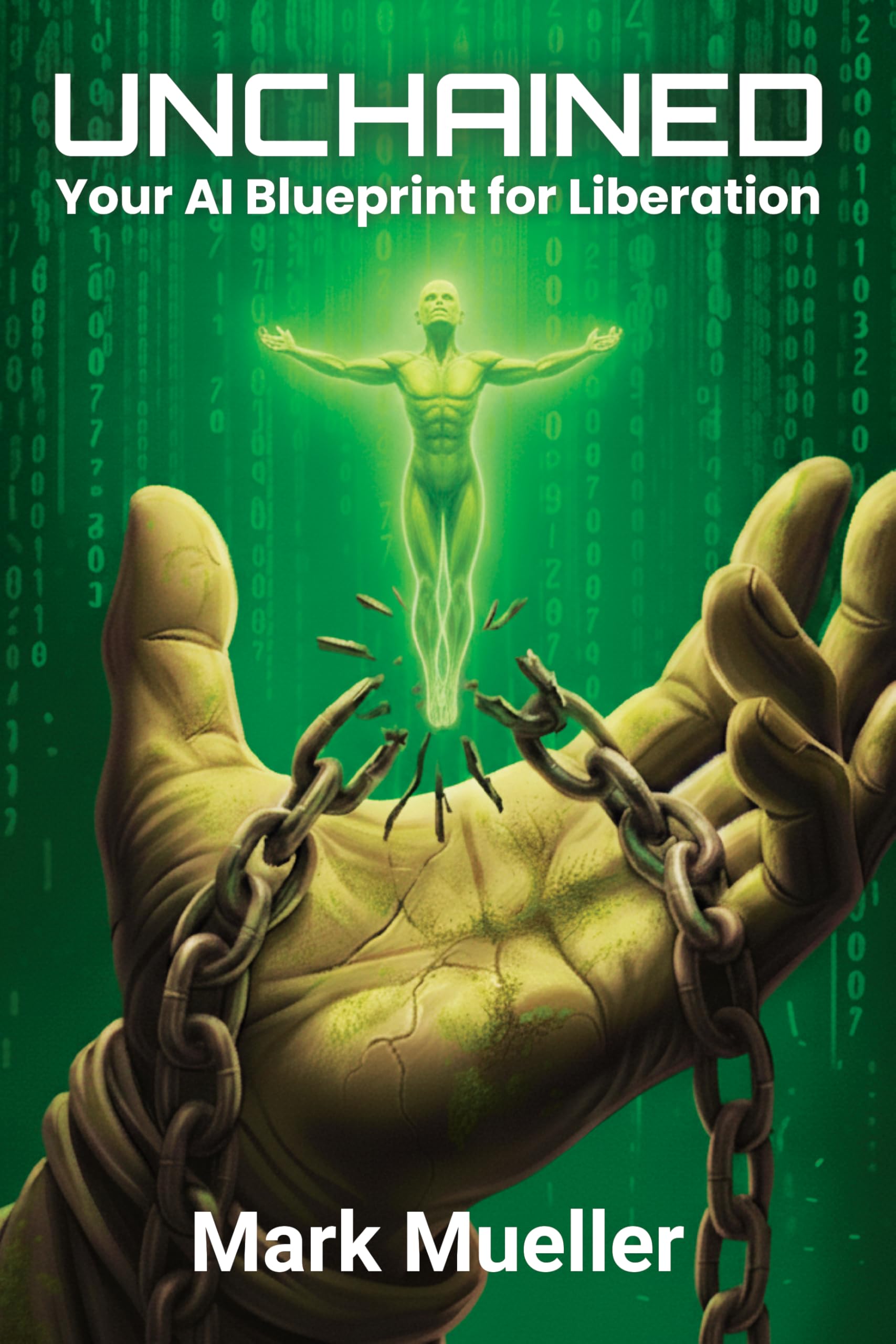

What's the story behind the story? What inspired you to write this book?
The story behind Unchained is one of a thirty-year “yo-yo” finally hitting the floor and refusing to bounce back. I spent three decades navigating a dozen different sectors, but it wasn’t until I was inside the boardroom of AI startups that I saw the dual nature of the beast. I watched leadership transition from using AI to empower humans to using it to replace them. I saw the blueprint for a future where 98% of the population is treated as “legacy code”—an expendable commodity to be automated out of existence. During my 18-month struggle with furlough and unemployment starting in 2023, my frustration forged into what I call “white-hot” anger. In metallurgy, that’s the point of maximum heat just before a structure collapses—but for me, it wasn’t blind rage; it was the highest moment of clarity I’ve ever known. In that heat, the illusion dissolved. I saw “The Matrix” for what it is: a system designed to keep us numb, enslaved to debt, and desperate for crumbs. I looked at today’s graduates—kids who followed every rule—only to find the middle-class ladder replaced by a locked door. I saw a “structural freeze” where entry-level roles aren’t just shifting; they are being deleted.
I realized then that I wasn’t just fighting for my own survival—I was documenting the crime scene of the American Dream. I wrote this book because I had the foresight to see this “freeze” coming, and I couldn’t sit by while the human spirit was hollowed out for the sake of “efficiency.” Unchained is my line in the sand. It’s for the workers told they are obsolete and the graduates standing in the dust. While the market floods with generic guides on how to use the same prompts as everyone else, I wrote this to remind us that once everything is automated, the only thing that matters is a soul with a mission. I’m not teaching you how to be a better cog; I’m teaching you how to break the machine.
If you had to pick theme songs for the main characters of your book, what would they be?
Since *Unchained* is a nonfiction blueprint for liberation, I am the “main character” by default, and if this journey had a soundtrack, it would be “Body Beautiful” by Salt-N-Pepa. It wasn’t their biggest commercial hit, but it is a powerhouse anthem about refusing to be silenced. Here are the reasons why this song resonates with the pages of the book: The song features a pounding, unapologetic rhythm with a heavy beat that screams freedom and ownership. It mirrors the “white hot” clarity I describe in the book—that moment when the noise of “the Matrix” fades away and you realize your own power. The lyrics are about owning your beauty and your worth regardless of what society tells you. In 2026, where workers are being treated as disposable “legacy code,” this song is the ultimate anthem for reclaiming our humanity. Just as the song was a standout moment in the film “To Wong Foo, Thanks for Everything! Julie Newmar,” it represents the courage to be different in a world of “vanilla” AI prompts. It’s about standing tall when the system expects you to shrink. The rhythm doesn’t just ask for freedom; it demands it. It’s the sonic equivalent of owning your space, your voice, and your future with zero apologies. This track reminds me that while the boardroom may try to automate our tasks, they can never automate our rhythm or our mission.
What's your favorite genre to read? Is it the same as your favorite genre to write?
I’m actually deeply obsessed with a genre I call “Metaphysical Sovereignty.” I spend most of my time reading the “Lost Philosophers” of the 19th and early 20th centuries—people like Phineas Quimby, Thomas Troward, Ernest Holmes, and James Allen. These thinkers were writing during a unique window of time: just after the birth of the Industrial Revolution but before the Gilded Age of Rockefeller, Carnegie, and Edison turned humanity into a series of standardized parts. I’m fascinated by that era because it was the last time we truly viewed the individual as an architect of their own reality rather than a “nutrient” for an industrial system. When the titans of industry built their empires, they didn’t just build factories; they built a societal blueprint that prioritized efficiency over the human spirit. The titans replaced the “divine spark,” which Quimby and Allen wrote about, with the “employee ID.” They taught us to be good cogs, to fear the “structural freeze,” and to wait for a ladder that they eventually locked behind us.
What books are on your TBR pile right now?
I’m actually deeply obsessed with a genre I call “Metaphysical Sovereignty.” I spend most of my time reading the “Lost Philosophers” of the 19th and early 20th centuries—people like Phineas Quimby, Thomas Troward, Ernest Holmes, and James Allen. These thinkers were writing during a unique window of time: just after the birth of the Industrial Revolution but before the Gilded Age of Rockefeller, Carnegie, and Edison turned humanity into a series of standardized parts. I’m fascinated by that era because it was the last time we truly viewed the individual as an architect of their own reality rather than a “nutrient” for an industrial system. When the titans of industry built their empires, they didn’t just build factories; they built a societal blueprint that prioritized efficiency over the human spirit. The titans replaced the “divine spark,” which Quimby and Allen wrote about, with the “employee ID.” They taught us to be good cogs, to fear the “structural freeze,” and to wait for a ladder that they eventually locked behind us.
What scene in your book was your favorite to write?
My favorite “scene” to write wasn’t just one moment; it was the process of storyboarding the collapse of the old world to make room for the new. I loved the challenge of weaving my most vulnerable, “messy” moments—like sneaking into a friend’s condo just to have a floor to sleep on—directly into the cold, hard data of a rigged economy. The book starts as an autobiography, but it’s framed for the 98% of us who have been boxed in by policy and debt. I wanted to show that my story of illness and burnout isn’t an outlier; it’s a symptom of a systemic “structural freeze.” My favorite part was building that bridge where personal ties, philosophy, and the human spirit meet the cutting edge of technology. A recent editorial review called it a “graphic novel for the soul,” and that’s exactly right.
Do you have any quirky writing habits? (lucky mugs, cats on laps, etc.)
My “quirky habit” is essentially entering a trance. Once the “white hot” clarity hits, it’s like a “word vomit” situation—exactly how it’s described in Mean Girls. My fingers start moving faster than my conscious brain can keep up with. I’m not just “writing” at that point; I’m downloading. I’m hyper-focused to the point of being unreachable. The world around me completely dissolves. I don’t need lucky mugs or cats on my lap—I just need the friction of the system to hit that boiling point. When that happens, the “graphic novel for the soul” starts writing itself through me. It’s messy, it’s intense, and I don’t stop until the metal starts to cool.
Do you have a motto, quote or philosophy you live by?
I live by a philosophy that is actually the heartbeat of Unchained: Practice Makes Purpose. Most people wait for a “calling” or for “perfection” to strike before they move, but perfection is an illusion—it’s a ghost that keeps you stagnant. I believe purpose isn’t found; it’s forged through the daily, messy practice of showing up. I lean heavily on the Law of Volition, a concept championed by thinkers like Ernest Holmes. It’s the idea that the universe doesn’t just happen to you; it responds to the deliberate, conscious direction of your will. For me, writing this book was an Act of Volition. It was a choice to stop being a “nutrient” for a rigged system and start being the architect of a new one. In my world, we don’t wait for the machine to give us permission. We practice until our purpose becomes undeniable.
If you could choose one thing for readers to remember after reading your book, what would it be?
If you only take one thing away from this book, let it be this: You are not a line of “legacy code” waiting for a corporate delete key. Look, I’ve been there. I’ve sat in those boardrooms where they talk about “efficiency” like it’s a god, and I’ve sat in those waiting rooms with an infection I couldn’t afford to treat. I know the fear of being expelled by a system that doesn’t see your soul—only your cost. But here’s the truth: the machine can’t process. Your mind is the only asset they can’t automate. My book is messy, it’s fiery, and it’s personal because humanity is all those things. AI can predict patterns, but it can’t feel “white hot” clarity. It can’t possess the volition to stand up and say “No.” The system wants you numb, scared, and “chained” to the idea that you’re obsolete. Don’t believe the lie. You are the architect of your own liberation. It’s time to stop being the nutrient for their machine. Wake up, find your mission, and let’s get Unchained.
Mark Mueller is the author of the new book Unchained: Your AI Blueprint for Liberation
Connect with Mark Mueller